Define GTM: what go-to-market means and how B2B teams run it
Quick answer
GTM means go-to-market: how a company takes a product to buyers and wins them as customers. A GTM strategy is the plan for it: who you sell to, what you say, what you charge and where you reach buyers. In B2B (selling to other businesses), sales, marketing, product and customer success run it together. One warning when you define GTM: in web analytics, the same letters mean Google Tag Manager.
 By Tim Scheuer, Co-founder of Oxygen · Reviewed October 23, 2026
GTM meaning: what does GTM stand for?
GTM stands for go-to-market: everything a company does to bring a product to buyers and turn them into customers. The written plan for it is a GTM strategy, which HubSpot calls a step-by-step plan for bringing a new product to market and driving demand.
People also say GTM for the team that runs the plan, as in "our GTM team".
In web analytics, GTM means Google Tag Manager, Google's system for managing tags on a website without changing its code.
Sources: HubSpot: what is a go-to-market strategy?, Salesforce: what is a go-to-market strategy?, HubSpot: revenue operations (RevOps) strategy, Google Tag Manager Help: introduction to Tag Manager
What is a GTM strategy, and what goes in it?
A GTM strategy is the written plan: who you sell to, what you tell them, what you charge and how you reach them. Salesforce lists its parts as the product, the target audience, the message, the channels, sales training and the numbers you track.
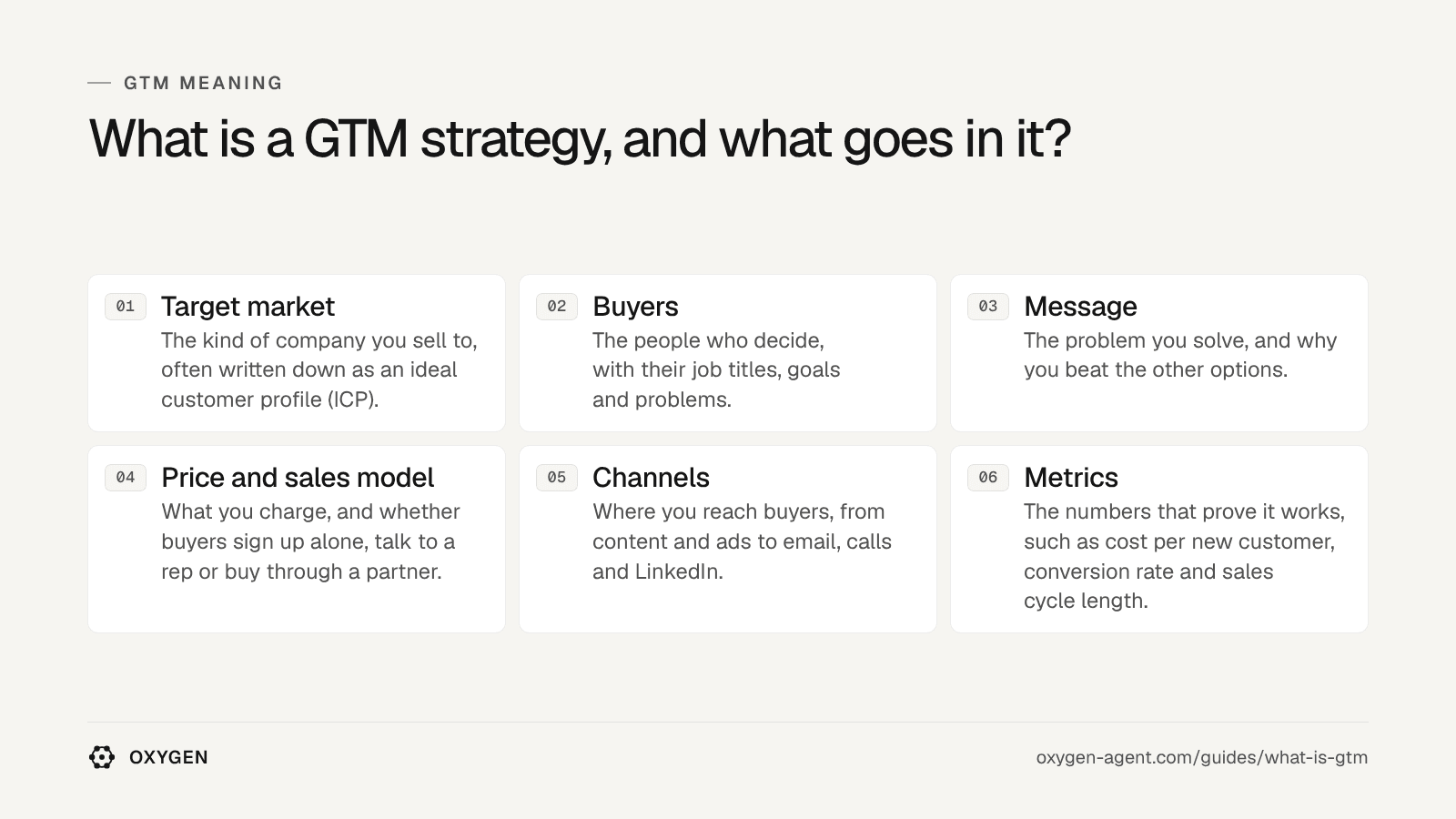
- Target market: the kind of company you sell to, often written down as an ideal customer profile (ICP).
- Buyers: the people who decide, with their job titles, goals and problems.
- Message: the problem you solve, and why you beat the other options.
- Price and sales model: what you charge, and whether buyers sign up alone, talk to a rep or buy through a partner.
- Channels: where you reach buyers, from content and ads to email, calls and LinkedIn.
- Metrics: the numbers that prove it works, such as cost per new customer, conversion rate and sales cycle length.
Sources: Salesforce: what is a go-to-market strategy?, HubSpot: what is a go-to-market strategy?
Why does GTM matter for a B2B team?
A B2B purchase is a group decision, and a GTM plan keeps every team aimed at the same accounts and people. HubSpot cites Gartner: a typical buying group for a complex B2B solution has six to ten decision-makers.
Salesforce makes the same point: B2B sales involve many stakeholders, while a B2C sale, to a consumer, usually has one decision-maker. That is why B2B GTM plans tend to be longer and more complex.
Without a shared plan, the failure is quiet. Marketing hands over leads that sales never works, and a rep writes to one contact while the rest of the buying group decides.
Sources: HubSpot: what is a go-to-market strategy?, Salesforce: what is a go-to-market strategy?
What are the main go-to-market models?
HubSpot names four go-to-market models: self-service, inside sales, field sales and channel, where a partner sells for you. Each one is a GTM motion, the path buyers take from first hearing about you to paying you.
Price and product complexity usually decide which one fits, and you can mix models by industry or customer size. Inbound, outbound or both then feed each model. With inbound, buyers find you through content, search or ads; with outbound, reps reach out first.
Four GTM sales models at a glance
HubSpot's four go-to-market sales models, with the kind of product each one fits. You can mix them by industry or customer size.
| Model | How buyers buy | Fits when |
|---|---|---|
| Self-service | Buyers find the product and buy on their own, often on your website | The product is simple, low priced and sold in high volume |
| Inside sales | A rep nurtures each deal; cycles run from a few weeks to a few months | The product has medium complexity and a medium price |
| Field sales | Experienced reps close large enterprise deals over a long cycle | The product is complex and has a high price point |
| Channel | A partner or agency sells your product for you | The product matches what the partner already sells |
How does a B2B team run GTM in practice?
In practice, GTM runs as a loop: pick the accounts, reach the people who decide, learn from the replies, then fix the plan. Here is one pass of that loop in OXYGEN, where AI does the research and drafting within the approvals and credit caps you set.
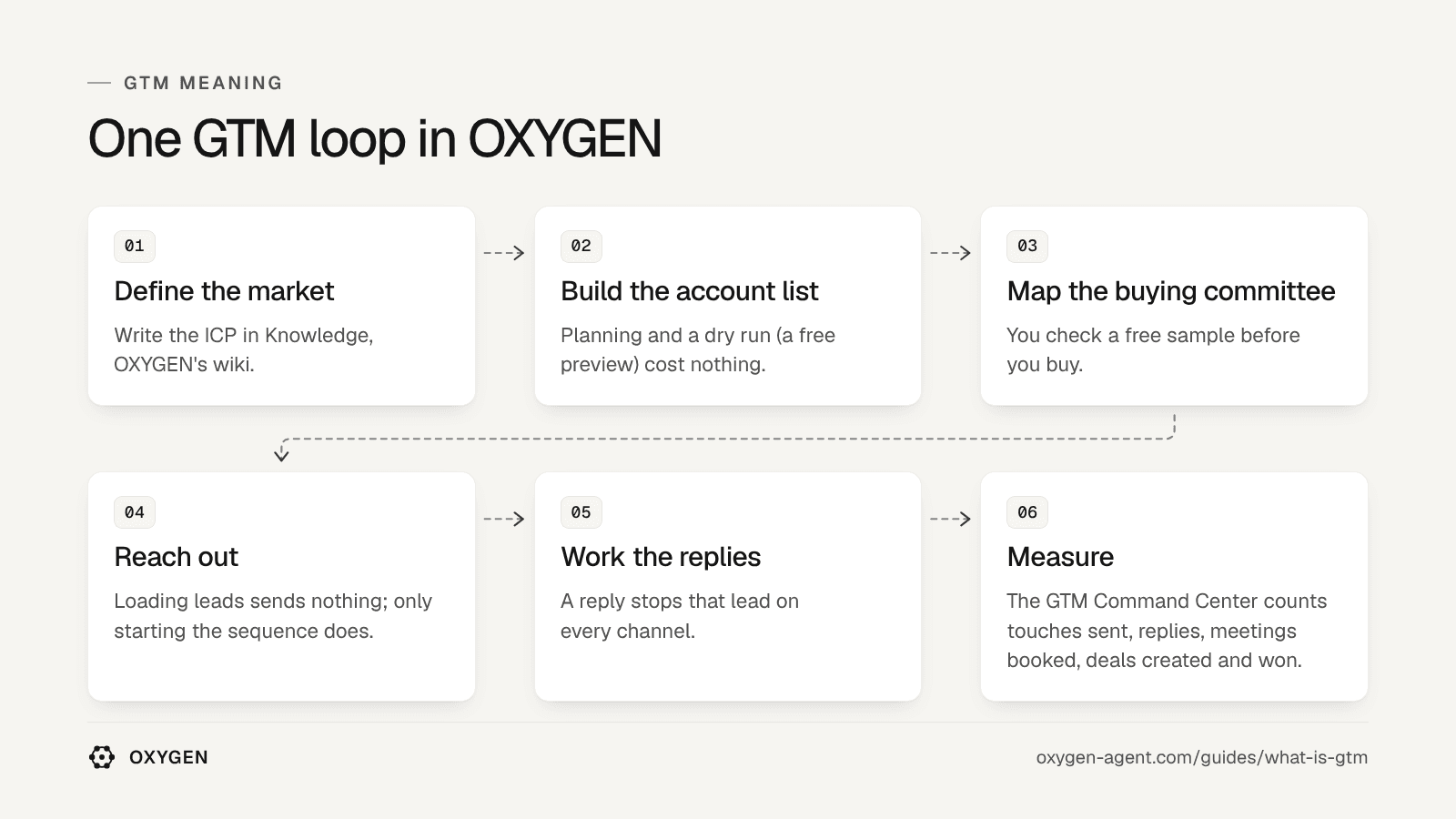
Say you sell fleet software to operations leaders at US logistics companies with 200 to 2,000 employees.
- Define the market: write the ICP in Knowledge, OXYGEN's wiki, naming the accounts you want, the buyer types (personas) and what rules an account out. OXYGEN's AI reads it to find and qualify leads and draft outreach.
- Build the account list: Company Search turns "US logistics companies with 200 to 2,000 employees" into a table. Planning and a dry run (a free preview) cost nothing; the live search needs your OK and a credit limit.
- Map the buying committee: Find decision makers at companies pulls the operations leaders at those accounts, by job level and function. You check a free sample before you buy.
- Reach out: one sequence runs email and LinkedIn steps for each lead. Loading leads sends nothing; only starting the sequence does.
- Work the replies: replies from every channel land in Unibox, and a reply stops that lead on every channel. A setting can pause the rest of their company too.
- Measure: deals move across the Pipeline board in OXYGEN's CRM, its database of companies, people and deals. The GTM Command Center counts touches sent, replies, meetings booked, deals created and won.
What mistakes do teams make with GTM?
Most GTM problems start before anyone sends a message: the plan is vague, or each team has its own.
- Selling to everyone: without a written ICP, lists grow wide and messages turn generic.
- Teams working from different plans: Salesforce names poor alignment between sales, marketing and product as a common challenge.
- A sales model that does not fit the price: HubSpot ties self-service to simple, low-priced products and field sales to complex, high-priced ones.
- Writing to one contact per account: reach the people who use, approve and pay for the product.
- Writing the plan once: Salesforce suggests a review at least every quarter, because buyers' needs change.
Sources: Salesforce: what is a go-to-market strategy?, HubSpot: what is a go-to-market strategy?
Related terms: GTM team, RevOps, ABM and more
The terms closest to GTM name who runs it and who it targets.
- GTM team: the people who run the plan, usually sales, marketing, product and customer success.
- RevOps (revenue operations): the function that lines up sales, marketing and customer success around shared data, processes and goals.
- ABM (account-based marketing): treating a short list of high-value accounts as markets of their own.
- SDR (sales development representative): the rep who qualifies new leads and books meetings for the people who close deals.
Sources: HubSpot: what is a go-to-market strategy?, HubSpot: revenue operations (RevOps) strategy, HubSpot: account-based marketing strategy, Salesforce: what is a sales development representative (SDR)?
What OXYGEN does not do here
- It does not set your GTM strategy: AI can research and draft, and your team still decides the market, the price and the positioning.
- No contact database of its own: lead data comes from data providers, on credits.
- No Salesforce sync; HubSpot syncs both ways, Attio one way, and Pipedrive imports.
- The GTM Command Center is not in the sidebar yet: open it at /dashboards, and read its conversion rates as directional.
Frequently asked questions
What does GTM stand for?
GTM stands for go-to-market: how a company brings a product to buyers, from who it targets to how it prices and sells. The written plan for it is called a GTM strategy.
Is GTM the same as Google Tag Manager?
No, they only share the letters. Google Tag Manager is Google's system for managing tags on websites and mobile apps. If the talk is about sales, marketing or a product launch, GTM means go-to-market.
What is the difference between a GTM strategy and a marketing strategy?
Scope and timing. HubSpot describes a GTM strategy as cross-functional, covering sales, marketing, pricing, distribution and customer success, and built before a launch or expansion. A marketing strategy is ongoing, owned by marketing, and focused on demand and brand awareness.
Who owns the GTM strategy?
Usually a group, not one team. Salesforce says sales leaders should pull together a GTM team from product, sales, finance, marketing and customer service. It adds that a revenue operations leader often keeps the plan current. In a small company, name one owner so the plan gets updated.
What is an example of a go-to-market strategy?
Salesforce gives one. A founder's software automates data entry, and she targets midsize retailers that take many orders online and by phone. Rival tools cost too much and take too long to set up. She pitches getting weekends back and hires 10 sales reps for outreach and demos.
How often should you update a GTM strategy?
Salesforce suggests reviewing it at least every quarter and updating it with the yearly budget. Revisit it sooner when you enter a new market or your messages stop landing.
Can a small B2B team run GTM in OXYGEN?
Yes. A free workspace comes with a one-time grant of 1,000 credits for lists and research. The CRM, Tables and Knowledge are free to use. Sending from your own mailbox or LinkedIn account needs a paid plan, from $49 a month.
Related
Sources
- HubSpot: what is a go-to-market strategy?, checked October 23, 2026
- Salesforce: what is a go-to-market strategy?, checked October 23, 2026
- HubSpot: revenue operations (RevOps) strategy, checked October 23, 2026
- HubSpot: account-based marketing strategy, checked October 23, 2026
- Salesforce: what is a sales development representative (SDR)?, checked October 23, 2026
- Google Tag Manager Help: introduction to Tag Manager, checked October 23, 2026
Reviewed October 23, 2026 by Tim Scheuer. OXYGEN's own prices and limits come from the product and its live price list. The other products named here are trademarks of their owners and are not affiliated with OXYGEN. Something out of date? Tell us.