SDR meaning: what a sales development representative does
Quick answer
The SDR meaning in sales is sales development representative: a rep who finds and qualifies new leads and books meetings for account executives (AEs). The AE then runs the sale and closes it. An SDR's day is research, cold email, calls, LinkedIn messages and follow-ups. Many teams use SDR and BDR (business development representative) for the same job. Others split them: SDRs answer leads who came to you, BDRs reach out cold.
 By Tim Scheuer, Co-founder of Oxygen · Reviewed October 22, 2026
SDR definition: what is an SDR in sales?
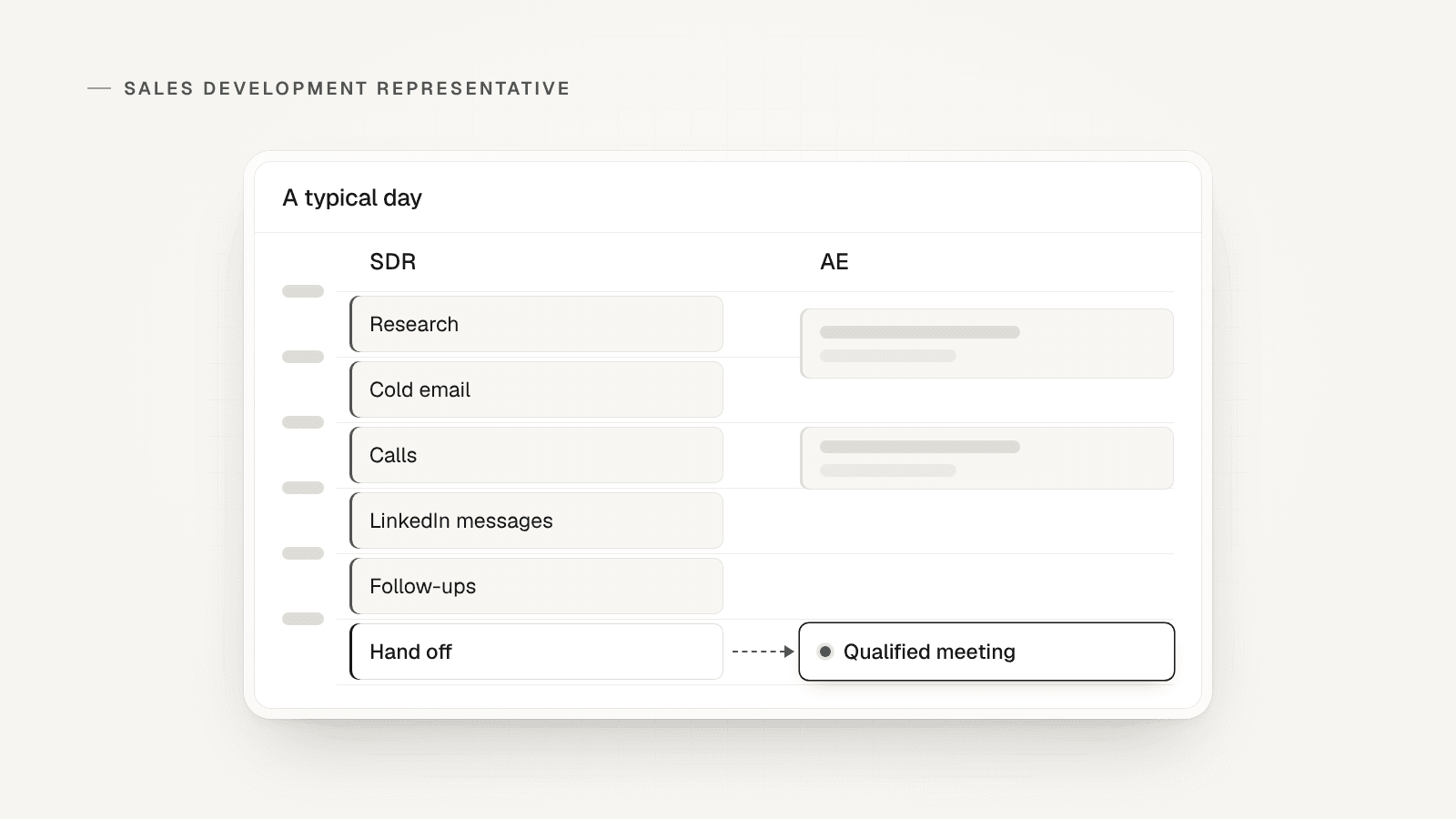
An SDR, short for sales development representative, is the salesperson who finds and qualifies new leads and books meetings for account executives. Salesforce puts the role at the top of the funnel: the work done before a prospect, someone who might buy, is ready to purchase.
SDRs do not close deals. Their job, in HubSpot's words, is to start conversations, qualify interest and hand opportunities to account executives.
In finance, SDR means special drawing rights, reserve assets created by the International Monetary Fund (IMF). In radio, it means software-defined radio.
Sources: Salesforce: what is a sales development representative (SDR)?, HubSpot: how to train your SDR team, BEA glossary: special drawing rights (SDR), VIAVI: what is software defined radio (SDR)?
SDR vs BDR vs AE: what is the difference?
The difference is where each role's work starts. In teams that split the jobs, SDRs qualify warm inbound leads, people who came to you, while BDRs prospect cold outbound accounts and AEs close.
Many companies use SDR and BDR for the same job. HubSpot notes that the split depends on company size and sales structure, so read the job description, not the title.
Sources: HubSpot glossary: business development representative, HubSpot: how to train your SDR team
SDR, BDR and AE at a glance
Where a team splits the roles, this is the usual line between them. Many teams merge the first two.
| Role | Main job | Where its leads come from | Measured by |
|---|---|---|---|
| SDR (sales development representative) | Qualifies interest and books meetings | Mostly inbound: website inquiries, content downloads and leads from marketing | Meetings held and new deals created |
| BDR (business development representative) | Finds new accounts and opens conversations | Mostly outbound: cold email and cold calls | Qualified meetings passed to AEs |
| AE (account executive) | Runs the sales cycle and closes the deal | Meetings booked by SDRs and BDRs | Revenue closed |
What does an SDR do in a day?
Most of the day goes to research, outreach and follow-up, all aimed at one result: a qualified meeting for an AE.
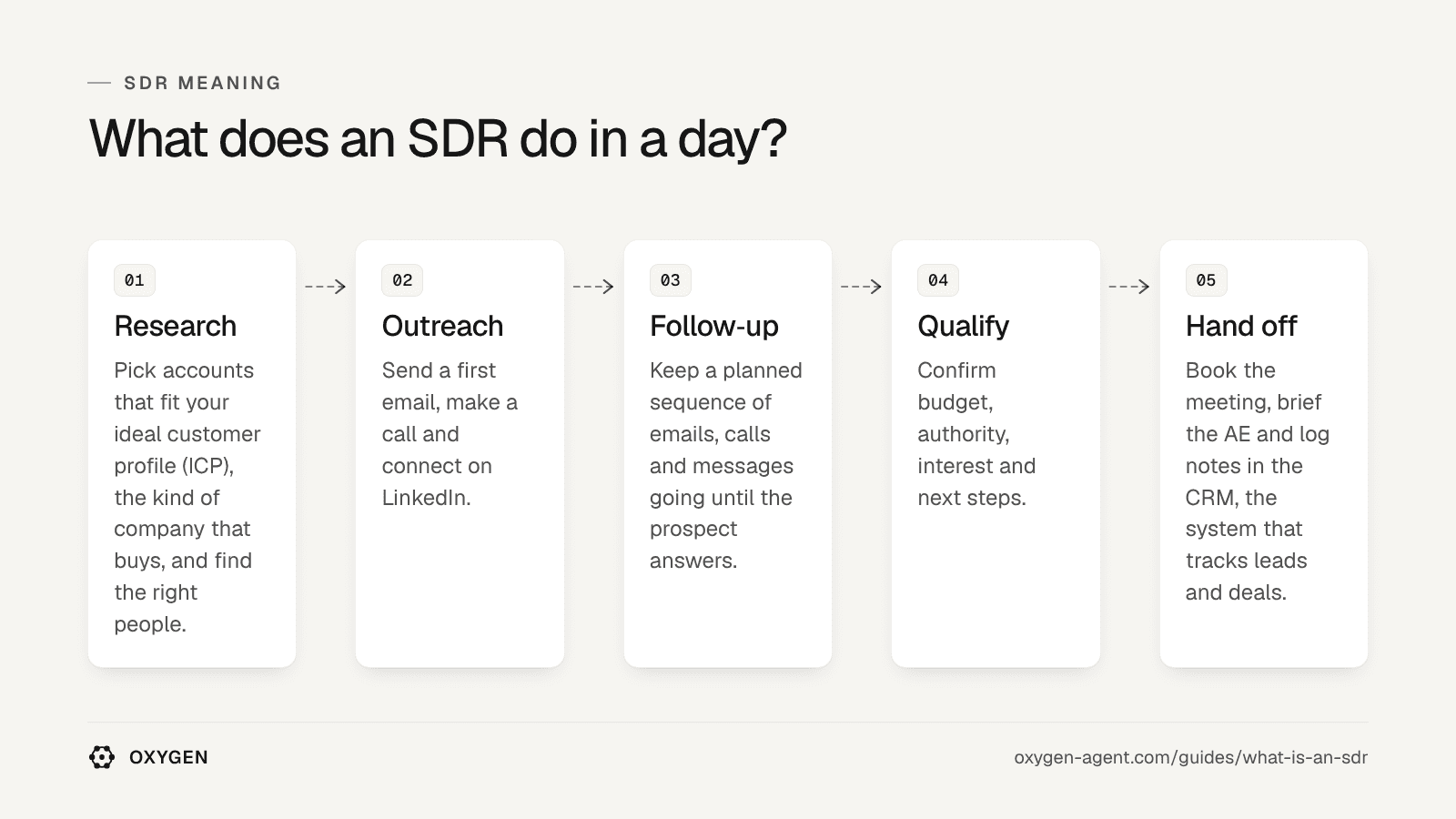
Teams that count qualified meetings research more; teams that count activity call and email more. The Bridge Group's 2025 survey of 351 B2B (business-to-business) companies puts the median target, or quota, at 10 held meetings a month.
- Research: pick accounts that fit your ideal customer profile (ICP), the kind of company that buys, and find the right people.
- Outreach: send a first email, make a call and connect on LinkedIn.
- Follow-up: keep a planned sequence of emails, calls and messages going until the prospect answers.
- Qualify: confirm budget, authority, interest and next steps.
- Hand off: book the meeting, brief the AE and log notes in the CRM, the system that tracks leads and deals.
Sources: Salesforce: what is a sales development representative (SDR)?, The Bridge Group: SDR Models, Motions and Metrics, 2025, HubSpot: how to train your SDR team
Why do B2B teams hire SDRs?
Teams hire SDRs so account executives can spend their time on deals instead of hunting for them. HubSpot, writing about BDRs, calls this specialization: one rep gets good at research and outreach, the other at negotiation.
Where teams have SDRs, The Bridge Group's 2025 survey found about one SDR for every 2.4 AEs.
Still, an SDR is rarely the right first sales hire. Until someone has closed deals and knows which message works, an SDR has nothing proven to repeat.
Sources: HubSpot glossary: business development representative, The Bridge Group: SDR Models, Motions and Metrics, 2025
How much does an SDR make?
The median SDR earns $80K a year at target, according to The Bridge Group's 2025 survey. That is a $55K base salary plus $25K in variable pay, earned in full by hitting quota.
Only 60% of SDRs were at quota in that survey, the lowest share in the study's history, so real pay often lands below target.
Sources: The Bridge Group: SDR Models, Motions and Metrics, 2025
How does an SDR find leads and book meetings?
The basic workflow rarely changes: build a list, find contact data, research each account, run a sequence and work the replies. Here is that week in OXYGEN, where AI does the research and the rep decides what goes out.
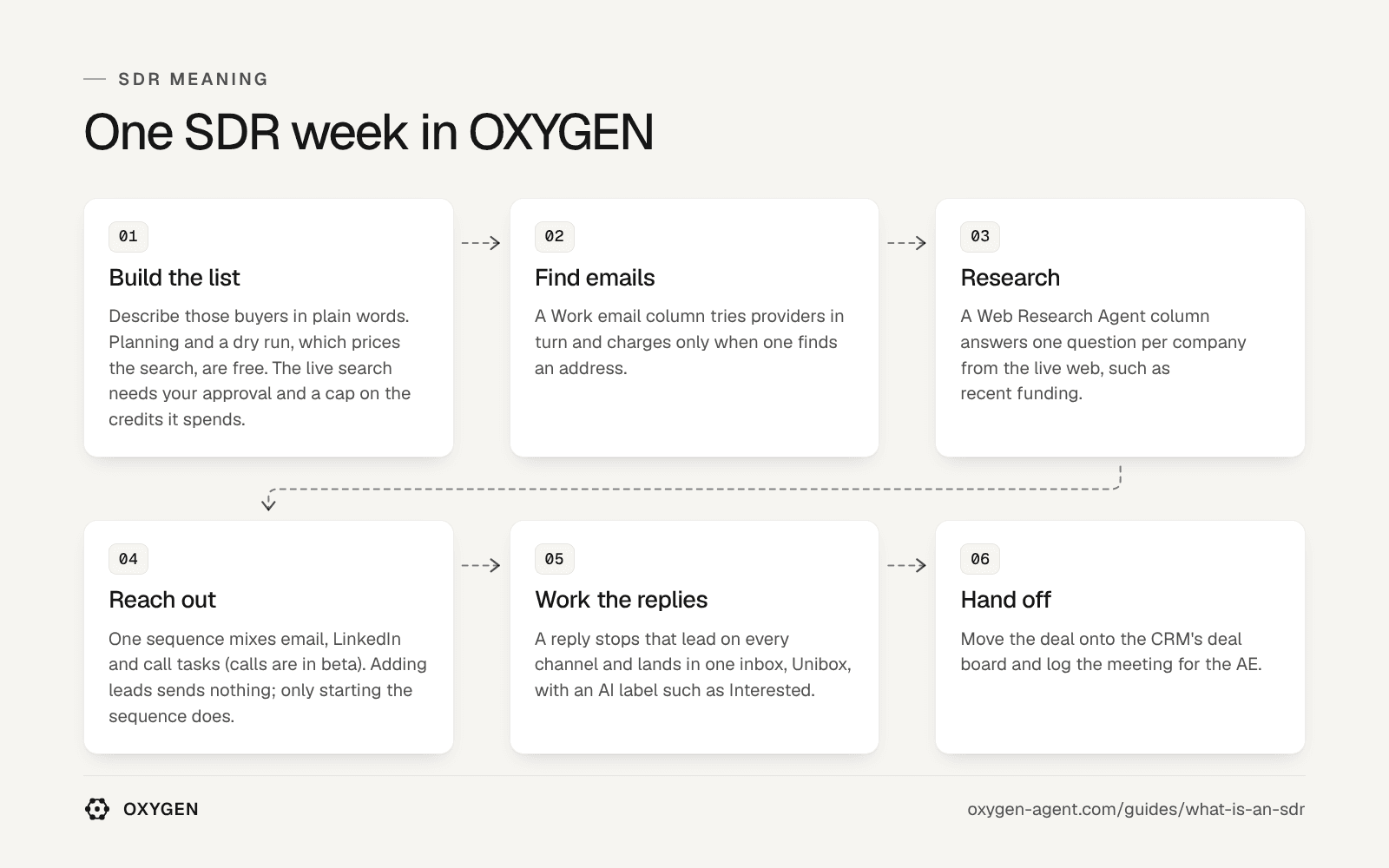
Say you sell to Heads of Sales at US software companies with 20 to 200 employees.
- Build the list: describe those buyers in plain words. Planning and a dry run, which prices the search, are free. The live search needs your approval and a cap on the credits it spends.
- Find emails: a Work email column tries providers in turn and charges only when one finds an address.
- Research: a Web Research Agent column answers one question per company from the live web, such as recent funding.
- Reach out: one sequence mixes email, LinkedIn and call tasks (calls are in beta). Adding leads sends nothing; only starting the sequence does.
- Work the replies: a reply stops that lead on every channel and lands in one inbox, Unibox, with an AI label such as Interested.
- Hand off: move the deal onto the CRM's deal board and log the meeting for the AE.
How are AI SDR tools changing the SDR role?
AI takes the repetitive parts first: research, list building and first drafts. Salesforce's view is that AI can't do the SDR's job, but it can draft personal emails for the rep to review and tweak.
Hands-off AI SDRs go further: they send outreach and handle replies once set up. Research-first tools draft the work and wait for a person to approve it. The Bridge Group's 2025 survey counted AI SDRs as their own category for the first time, at 1% of respondents.
So the real question is how much the AI may send unchecked. Our AI sales agents guide explains both models, and the AI SDR tools guide compares seven tools.
Sources: Salesforce: what is a sales development representative (SDR)?, The Bridge Group: SDR Models, Motions and Metrics, 2025
What mistakes do teams make with SDRs?
Most come down to measuring the wrong thing or handing off too early.
- Counting activity, not results: meetings held and new deals matter more than calls and emails sent.
- Booking meetings that go nowhere: confirm budget, authority, interest and next steps before a call reaches the AE's calendar.
- Blurring SDR and BDR: if nobody owns inbound or outbound, leads wait or get two emails.
- Expecting results in week one: a new SDR takes 3 months to reach full speed, on average, per The Bridge Group.
- Blasting one template to a big list: Google tells senders to keep reported spam under 0.1% and never reach 0.3%.
Sources: The Bridge Group: SDR Models, Motions and Metrics, 2025, HubSpot: how to train your SDR team, Google: email sender guidelines
Related terms: BDR, AE, ICP and more
These four terms come up most around the SDR role.
- BDR (business development representative): a prospecting rep, usually outbound, and at many companies another name for SDR.
- AE (account executive): the salesperson who runs the sales cycle and closes the deal.
- ICP (ideal customer profile): the kind of company most likely to buy, used to choose accounts.
- Sequence or cadence: a planned series of emails, calls and LinkedIn messages to one lead that stops when they reply.
Sources: HubSpot glossary: business development representative
What OXYGEN does not do here
- No hands-off AI SDR that finds leads, sends and books meetings on its own; a person or your own AI assistant runs the work.
- No contact database of its own: lead data comes from data providers, on credits.
- Calls are in beta: a call task queues the lead for a person to dial in the web softphone.
- No Salesforce sync; HubSpot syncs both ways.
Frequently asked questions
What does SDR stand for?
SDR stands for sales development representative, often shortened to sales development rep. An SDR finds and qualifies new leads and books meetings for account executives.
Is an SDR the same as a BDR?
Often, yes: many companies use the two titles for the same job. When a team splits them, SDRs answer inbound leads and BDRs prospect outbound with cold email and calls.
Is SDR an entry-level job?
Usually, yes. Salesforce notes that SDR roles have long been seen as entry level, though the job needs a specialized skill set. The average SDR stays in the role about 1.9 years, according to The Bridge Group's 2025 survey.
How many meetings should an SDR book?
The median quota is 10 held meetings a month, according to The Bridge Group's 2025 survey. Count meetings that happen, not meetings booked, and set your own target from your data.
Will AI replace SDRs?
AI already does much of the research and first drafts, and some AI SDR tools send and reply on their own. Expect the job to shift toward judgment, replies and live calls rather than disappear.
Can a small team do SDR work without hiring an SDR?
Yes. A founder or AE can run the same steps in OXYGEN, from building the list to working replies in one inbox. A free workspace has 1,000 credits for the list and research; sending needs a paid plan from $49 a month.
Related
Sources
- Salesforce: what is a sales development representative (SDR)?, checked October 22, 2026
- HubSpot glossary: business development representative, checked October 22, 2026
- HubSpot: how to train your SDR team, checked October 22, 2026
- The Bridge Group: SDR Models, Motions and Metrics, 2025, checked October 22, 2026
- Google: email sender guidelines, checked October 22, 2026
- BEA glossary: special drawing rights (SDR), checked October 22, 2026
- VIAVI: what is software defined radio (SDR)?, checked October 22, 2026
Reviewed October 22, 2026 by Tim Scheuer. OXYGEN's own prices and limits come from the product and its live price list. The other products named here are trademarks of their owners and are not affiliated with OXYGEN. Something out of date? Tell us.