
Your first session
Read what Home is telling you, connect the CLI, and create your first table without spending a credit.
Sign-up drops you on /home. It is a standup, not a dashboard: what happened since you last looked, what is waiting on you, and everything your workspace has done.
Getting here ran sign-up → create organization (your company website is the one required field: OXYGEN reads it once to seed your workspace knowledge) → How did you hear about us? → /home. There is no plan to pick, no trial, and no checkout on the way in.
What the free tier gives you
1,000 credits, granted once at signup, no card, no clock. Nothing expires and nothing is charged. You can build an entire outbound motion before you pay anything: source a list, enrich it, score it, write the sequence, and enrol recipients. Plan prices, included credits, and what each unit costs: pricing reference.
There is nothing to stop and no charge to avoid. When you want to send, publish, buy managed inboxes or domains, or use your own provider keys, upgrade from Billing & credits (sidebar footer → Settings → /settings#/billing). Everything you built on the free tier carries straight over. Under the 2026-09 repricing, credits alone cover sending, publishing and managed infrastructure once connected accounts reserve credits, and your own provider keys need the $99 plan or above (billing).
Reading Home
The headline sentence. On a new workspace: Nothing has gone out yet. Once sequences run it becomes the count that matters — Since yesterday Oxygen sent 240 emails. 6 people replied, 2 positively. — measured from your previous visit.
Needs you. Up to three chips under the headline, ordered by what it costs to ignore them: 1 sending inbox needs attention, 2 runs failed, 3 positive replies waiting on you. Each links to the screen that owns that queue. Zero-count rows are never drawn, so no chips means nothing is waiting.
Action timeline. One square per day; the header reads One square is one state-changing request. Four numbers above it: Actions, Current streak, Active days, Busiest day. Click a square and the Day recap lists that day's actions, each linking into Observability with its trace.
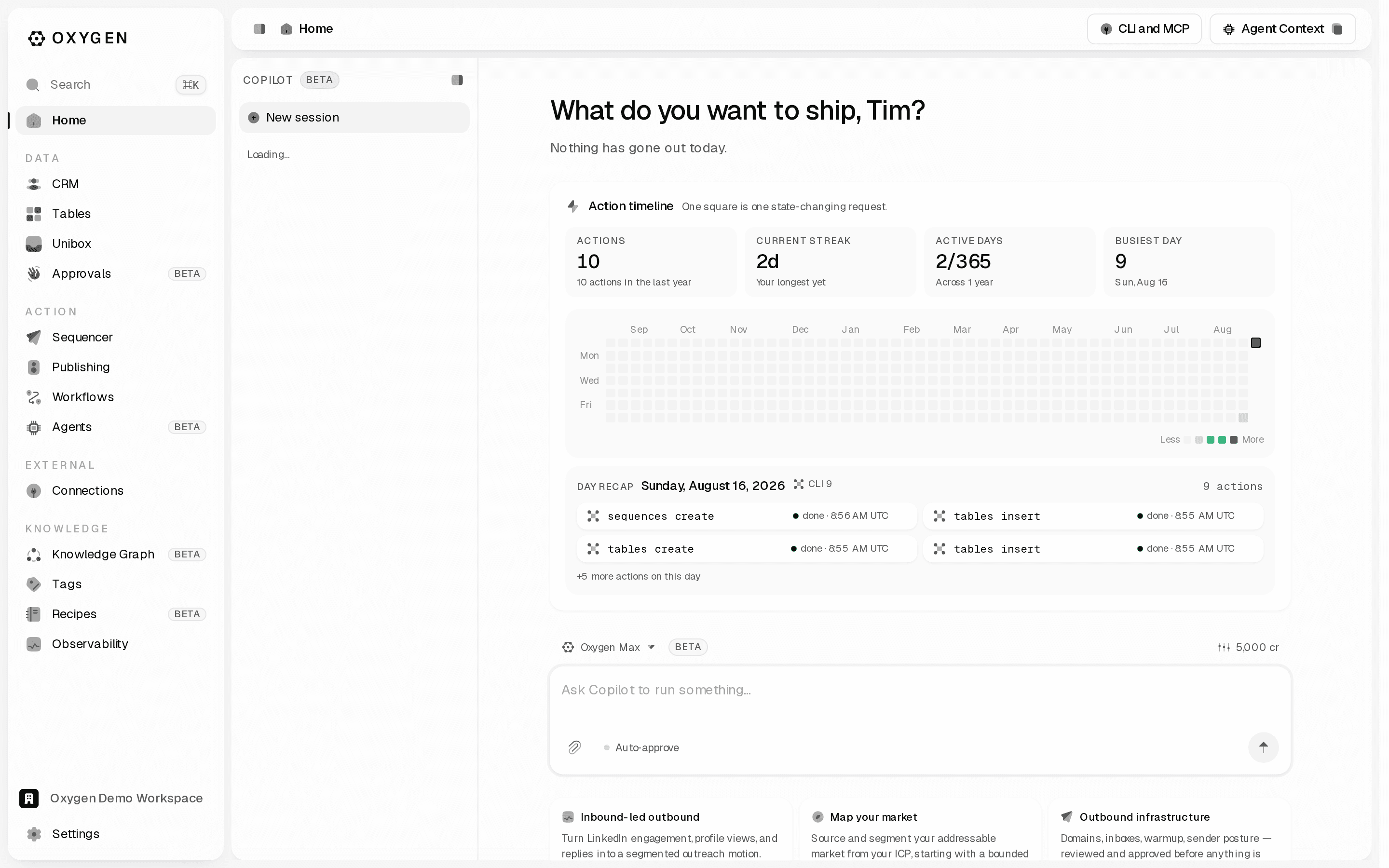
Same composition in the terminal, read-only and 0 credits:
oxygen home --jsonThe sidebar
| Group | Item | What it holds |
|---|---|---|
Home /home | The standup above. | |
| Data | CRM /crm | Companies, people, deals, and their timelines. |
| Data | Tables /tables | Working datasets — lists, enrichment, scoring. |
| Data | Unibox /unibox | Email, LinkedIn, and WhatsApp conversations in one inbox. |
| Action | Sequencer /sequencer | Outbound programs, sending accounts, analytics. |
| Action | Publishing /publishing | Scheduled posts and their engagement. |
| Action | Workflows /workflows | Deterministic multi-step automations. |
| External | Connections /connections | Provider accounts and API keys. |
| Knowledge | Tags /tags | Shared vocabulary across records, tables, and campaigns. |
| Knowledge | Observability /observability | Every run, its cost, and its provenance. |
Agents, Knowledge Graph, Recipes, and Approvals appear only once an organization turns on Beta features in Settings. Cmd-K opens a palette that jumps to any visible destination by name.
Where credits live
The sidebar footer holds the workspace switcher and a settings popover. Billing & credits (/settings#/billing) there answers every money question in one place: your plan, top-ups, seats and cancellation, and below them where credits went — by feature, provider, and day. From the CLI, oxygen billing balance --json and oxygen billing usage --json.
Connect the CLI
Home's top bar has a CLI and MCP button (Home only — other pages give that space to their own actions). It opens the same setup block as the settings popover's CLI and MCP entry at /settings/cli.
npm install -g @oxygen-agent/cli
oxygen login
Needs Node.js 22.22.0+ and npm 10.9.0+. oxygen login opens the browser and waits; check the confirmation code matches your terminal, then click Approve this terminal.
If the handoff never completes — no browser on that box, a network that blocks the wait — the terminal prints the manual path. On /settings/cli, click Create session and paste the oxygen login --token <token> line it shows into that terminal. The token is shown once.
Confirm you are connected, against the right workspace:
oxygen whoami --json
oxygen orgs list --json
oxygen orgs use <slug>
The CLI updates itself, including when a command fails with cli_update_required because it is older than the deployed API. If automatic updates are off (see Updates), run oxygen update and retry. oxygen status --json compares the two versions directly.
Using an MCP client instead of a terminal? The panel's MCP tab prints the endpoint and per-client steps; MCP setup has the full list.
A first action that costs nothing
Create a table and look at it.
Click Tables in the sidebar. An empty workspace opens the source picker straight away; otherwise click New table in the table rail (/tables/new). The picker lists every way a table can start — a file or a public link, Supabase or HubSpot, company and people searches (including lookalikes and local businesses on Google Maps), signal feeds, a webhook, a Function draft — and under each card the number of providers behind it and what a row costs, before anything runs. Pick Blank table: it creates a table named New table with one text column, Name, and opens the grid. Rename it in the breadcrumb. The grid's controls are Import rows, Add column and Export CSV in the toolbar, a magnifier in the breadcrumb that searches the rows, and New row as the last row of the grid itself — rows are appended at the bottom, where that button is.
The same thing from the terminal:
oxygen tables create "First list" \
  --columns-json '[{"key":"company","label":"Company","dataType":"text"},{"key":"domain","label":"Domain","dataType":"text"}]' \
  --json
oxygen tables list --json
oxygen tables preview <table-id-or-slug> --limit 10 --json
The create response carries a web_url. Open it and you are looking at the same grid.
Blank table and Import a CSV spend nothing. Every other card on that screen — the Total addressable market and Signals groups — runs a priced provider search, as do AI columns, enrichment columns, and sending. Those paths price the work first and wait for your approval: approvals, spend caps.