Meaning of ICP: what an ideal customer profile is and how to write one
Quick answer
The meaning of ICP in sales is ideal customer profile: a short description of the companies most likely to buy from you and stay. It lists firmographic facts, such as industry, size and location, and technographic facts, such as the software they use. A buyer persona then describes the people you sell to inside those companies. In medicine, ICP means intracranial pressure.
 By Tim Scheuer, Co-founder of Oxygen · Reviewed October 23, 2026
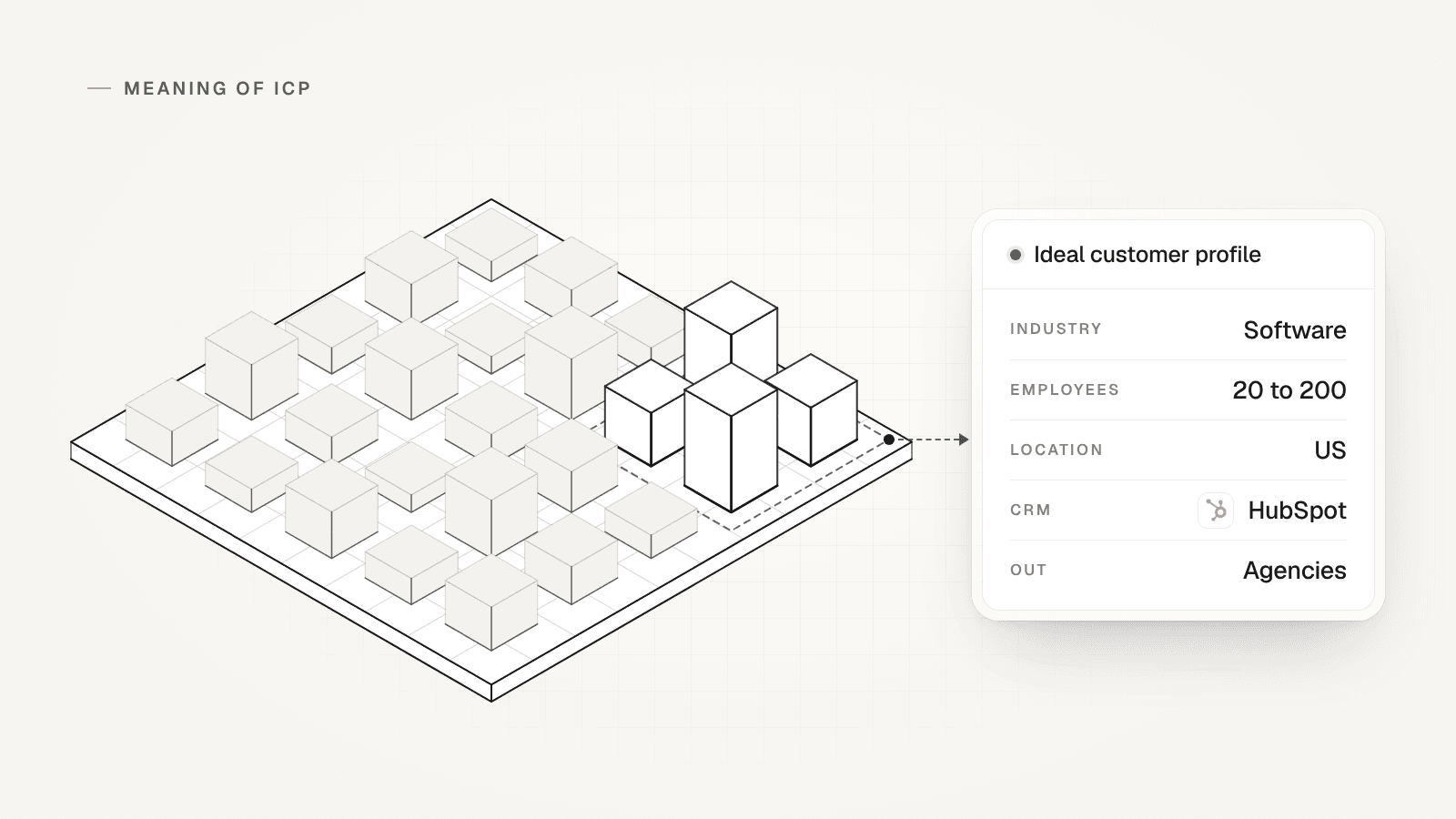
ICP definition: what does ICP mean in sales and business?
ICP stands for ideal customer profile, a description of the kind of company that gets the most value from what you sell. Salesforce calls it a detailed description of a buyer who is a perfect fit.
Teams use it to decide which companies sales should call and marketing should target. ICPs are most common in B2B (business-to-business) sales, where you sell to companies rather than shoppers.
ICP has other meanings too. In medicine, it means intracranial pressure, the pressure inside the skull. It is also short for Insane Clown Posse, a hip-hop duo from Detroit.
Sources: Salesforce: what's an ideal customer profile (ICP)?, Weill Cornell Neurological Surgery: intracranial pressure (ICP), Wikipedia: Insane Clown Posse
ICP vs buyer persona: what is the difference?
An ICP describes a company, while a buyer persona describes a person at that company. In HubSpot's words, your ICP identifies which companies to target, and your persona helps you reach the decision-makers inside them.
So the ICP decides who goes on your list, and the persona decides what you say to them. Salesforce calls a persona a semi-fictional picture of an ideal buyer, based on research and data. Most B2B teams need both.
Sources: HubSpot: how to create detailed buyer personas, Salesforce: what's an ideal customer profile (ICP)?
ICP vs buyer persona at a glance
Both describe who you sell to. The ICP works at the level of the company, the persona at the level of the person.
| Question | ICP (ideal customer profile) | Buyer persona |
|---|---|---|
| What it describes | A type of company | One person who buys or decides |
| What goes in it | Firmographic and technographic facts: industry, size, revenue, tech stack | Goals, challenges, behaviors and reasons to buy |
| What it answers | Which companies should we target? | How do we reach and convince the buyer? |
| Built from | Data on your best customers | Interviews with customers and possible buyers |
| Example | US software companies with 20 to 200 employees that use HubSpot | A Head of Sales who owns the sales target and needs more meetings |
Why does an ICP matter for a B2B team?
A clear ICP keeps a team from chasing every lead. Sales, marketing and the reps who book meetings work one short list, so time goes to companies likely to buy, renew and stay.
It also makes outreach easier: when every company on a list shares one problem, one message can speak to it. Salesforce's State of Sales report found that 86% of business buyers say they are more likely to buy when their goals are understood.
Skip it, and the list fills with companies that will never buy. You still pay to find their data and to email each one.
Sources: Salesforce: what's an ideal customer profile (ICP)?
What goes in an ICP? Firmographic and technographic fields
Most ICPs pair firmographic fields, facts about the company, with technographic fields, the tools it runs. The useful ones also name the problem that makes a company buy now, and who is out.
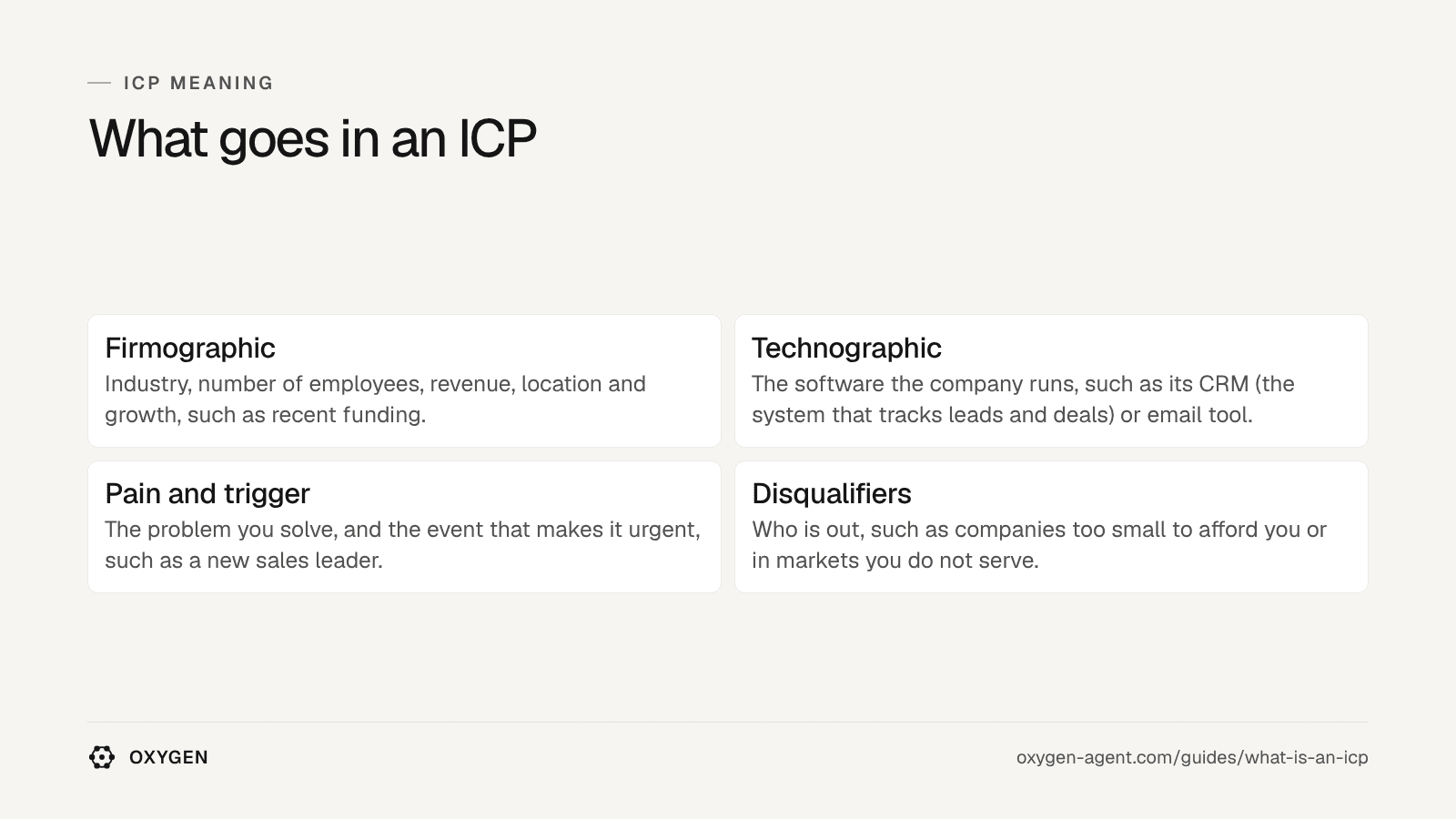
- Firmographic: industry, number of employees, revenue, location and growth, such as recent funding.
- Technographic: the software the company runs, such as its CRM (the system that tracks leads and deals) or email tool.
- Pain and trigger: the problem you solve, and the event that makes it urgent, such as a new sales leader.
- Disqualifiers: who is out, such as companies too small to afford you or in markets you do not serve.
Sources: Salesforce: what's an ideal customer profile (ICP)?, HubSpot: how to create detailed buyer personas
How do you write an ICP? Five steps
Build it in five steps: list your best customers, find what they share, ask a few of them, write it down and test it. Salesforce advises analyzing your best current customers first: they already pay, stay loyal and are likely to refer others.
A finished ICP fits in two sentences. Here is one: US B2B software companies with 20 to 200 employees that use HubSpot and just hired a first Head of Sales. Out: agencies and companies with no sales team.
- List your best customers: the ones who pay the most, stay the longest and were easiest to close.
- Find what they share: industry, size, location, tools and the problem they bought you to fix.
- Ask a few of them: why they chose you, what they value most and what else they looked at.
- Write it down: one or two sentences, then the fields and who is out.
- Test and update it: run it as a search, check what comes back and revise it as your market changes.
Sources: Salesforce: what's an ideal customer profile (ICP)?
How do you turn an ICP into a list of leads?
Turn each field into a search filter, then check every company before anyone reaches out. Here is that work in OXYGEN.
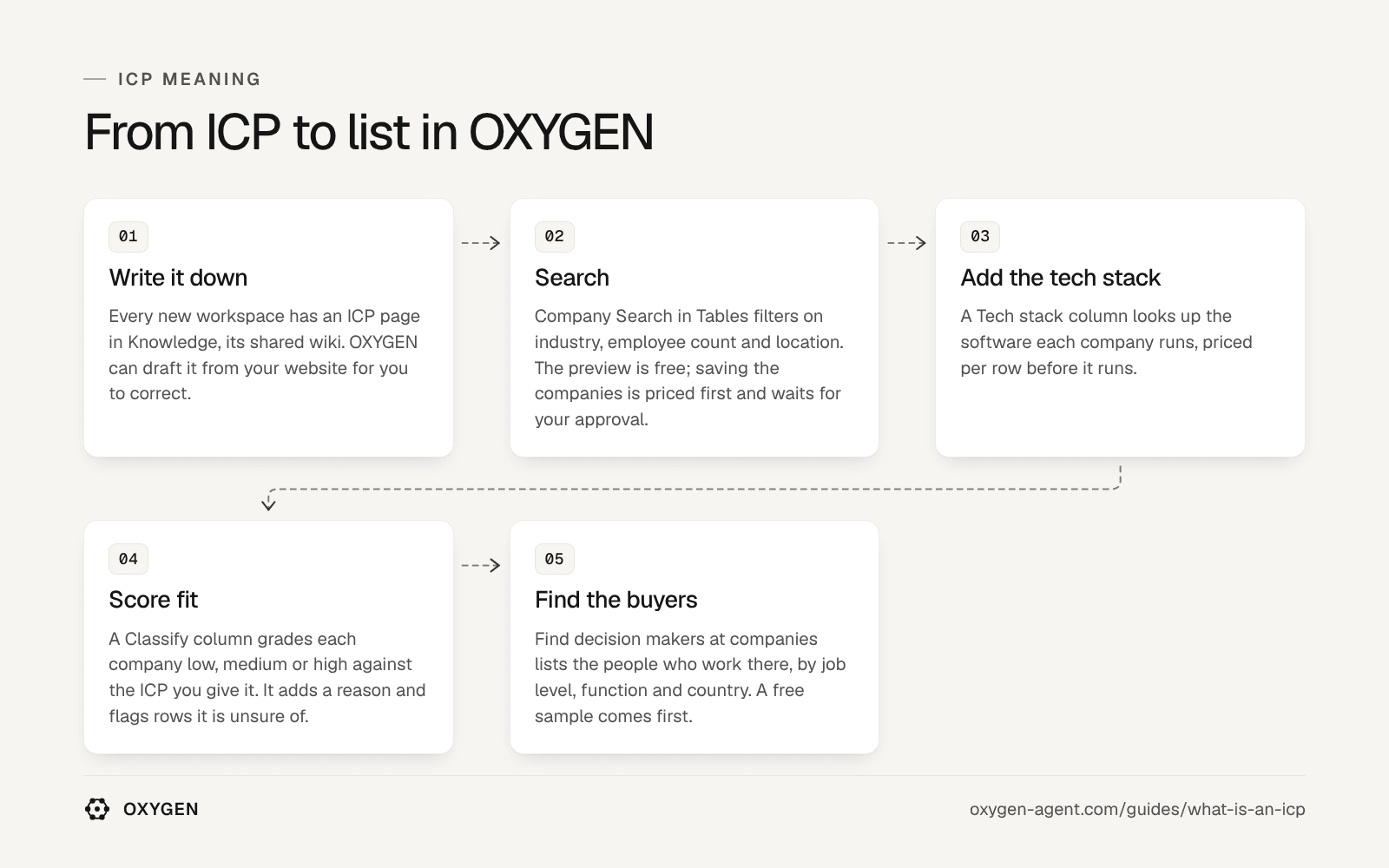
- Write it down: every new workspace has an ICP page in Knowledge, its shared wiki. OXYGEN can draft it from your website for you to correct.
- Search: Company Search in Tables filters on industry, employee count and location. The preview is free; saving the companies is priced first and waits for your approval.
- Add the tech stack: a Tech stack column looks up the software each company runs, priced per row before it runs.
- Score fit: a Classify column grades each company low, medium or high against the ICP you give it. It adds a reason and flags rows it is unsure of.
- Find the buyers: Find decision makers at companies lists the people who work there, by job level, function and country. A free sample comes first.
What mistakes do teams make with an ICP?
Most come down to going too broad or guessing instead of checking.
- Going too broad: Salesforce calls casting too wide a net the number one mistake. If almost any company fits, you have a market, not a profile.
- Guessing instead of checking: build it from real customer data, such as revenue, sales cycles and product use.
- Ignoring the people who talk to customers: sales and customer success hear objections and motives first.
- Leaving out the pain: size and industry say who could buy; the problem you solve says who will.
- Never updating it: an ICP should change as your company, market and data change.
Sources: Salesforce: what's an ideal customer profile (ICP)?
Related terms: buyer persona, firmographics, SDR and more
Firmographics and technographics are what an ICP is built from, and a buyer persona describes the people inside the companies it names.
- Buyer persona: a research-based profile of one buyer at your ICP companies, with their goals and challenges.
- Negative persona: a type of buyer you choose not to target because they are unlikely to buy.
- Firmographics: facts about a company, such as industry, size, revenue and location.
- Technographics: the software, hardware and digital tools a company uses.
- SDR (sales development representative): the rep who builds lists of companies that fit, qualifies leads and books meetings.
Sources: HubSpot: how to create detailed buyer personas, Salesforce: what's an ideal customer profile (ICP)?, Salesforce: what is a sales development representative (SDR)?
What OXYGEN does not do here
- No contact database of its own: company and people data come from data providers, on credits.
- Company Search in the app has no technology filter; check the tech stack with a paid column on the companies you keep.
- A fit score judges only the data in the row. It flags the rows it is unsure of, but check rows with missing facts too.
- Find decision makers at companies needs a column with each company's LinkedIn URL.
Frequently asked questions
What does ICP stand for?
In sales and marketing, ICP stands for ideal customer profile: the companies most likely to buy from you and stay. In medicine, it stands for intracranial pressure.
What is an example of an ICP?
A B2B example: US software companies with 20 to 200 employees that use HubSpot and just hired a first Head of Sales. It names an industry, size, location, tool and trigger, so anyone can tell if a company fits.
What does ICP mean in marketing?
The same as in sales: ideal customer profile. Marketing uses it to choose which companies to reach with ads and content, so the leads it hands to sales already fit.
Can a company have more than one ICP?
Yes. Salesforce notes that many businesses create several ICPs for different customer segments, industries or product use cases. Keep each narrow, with its own list and message.
How often should you update your ICP?
Review it regularly. Salesforce says an ICP should evolve as your business grows, new markets open and customer behavior changes. Your closed deals are the best check: compare the companies that bought with the profile.
How many interviews do you need for an ICP or a persona?
HubSpot suggests starting with at least three to five interviews per buyer persona, mixing customers, possible buyers and people who don't know your company. For the ICP itself, start from the data on your best customers.
How do I find companies that match my ICP?
Turn each field into a search filter, then check every company before outreach. In OXYGEN, Company Search previews matching companies for free. A free workspace has 1,000 credits to save them and add data such as their tech stack.
Related
Sources
- Salesforce: what's an ideal customer profile (ICP)?, checked October 23, 2026
- HubSpot: how to create detailed buyer personas, checked October 23, 2026
- Salesforce: what is a sales development representative (SDR)?, checked October 23, 2026
- Weill Cornell Neurological Surgery: intracranial pressure (ICP), checked October 23, 2026
- Wikipedia: Insane Clown Posse, checked October 23, 2026
Reviewed October 23, 2026 by Tim Scheuer. OXYGEN's own prices and limits come from the product and its live price list. The other products named here are trademarks of their owners and are not affiliated with OXYGEN. Something out of date? Tell us.