Clay pricing: plans, credits and what 1,000 contacts cost
Quick answer
Clay pricing has two meters. Actions pay for the work Clay runs: one per lookup, AI run or record sent to another tool. Data credits pay for the data it buys, such as emails and phone numbers. Free is for testing. Launch, the cheapest paid plan, adds phone numbers and sending. Growth adds CRM sync, which keeps a customer database such as HubSpot up to date, and connections to other tools. Enterprise is priced by quote.
 By Tim Scheuer, Co-founder of Oxygen · Reviewed October 24, 2026
How much does Clay cost?
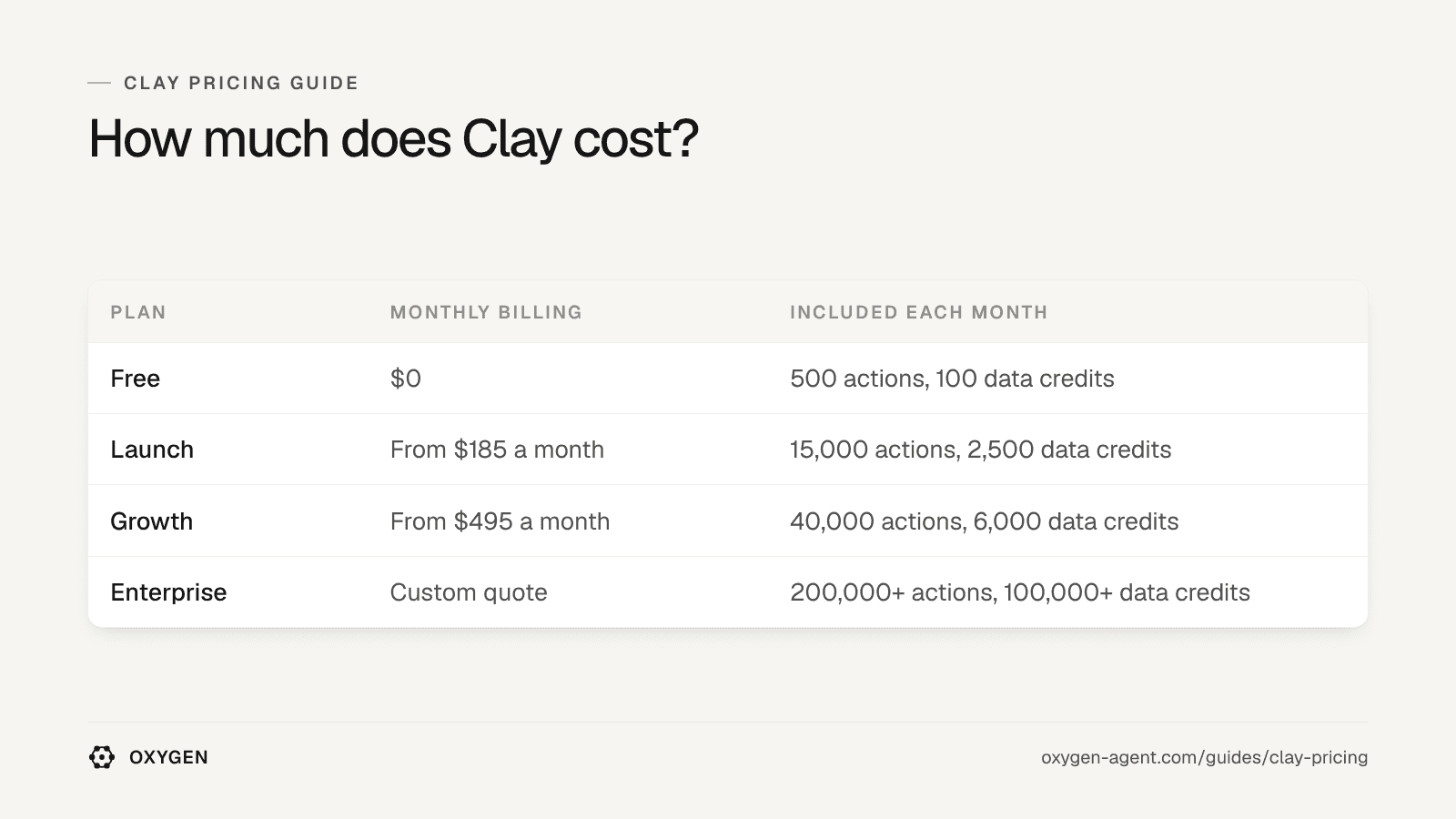
Clay's Launch plan starts at $185 a month, or $167 a month billed yearly. Growth starts at $495 a month, or $446 billed yearly. Free costs nothing, and Enterprise is a custom quote with a yearly contract. A 14-day trial with 1,000 data credits covers the paid features except phone numbers.
Each starting price is the smallest bundle on that plan. You pick an action tier and a data credit tier, and the price is the sum of the two. On monthly Launch, 15,000 actions cost $60 and 2,500 data credits cost $125, which makes the $185. Growth's $495 is 40,000 actions for $205 plus 6,000 credits for $290. Bigger tiers raise each part.
Seats are free on every plan. Clay's FAQ says you can add as many people to a workspace as you like at no charge. You pay per workspace, your team's shared Clay account, not per person.
Sources: Clay pricing, Clay docs: plans and billing, Clay FAQ: adding people to a workspace
Clay's plans at a glance
Starting prices and what each plan adds, from Clay's pricing page and docs on October 24, 2026. Every plan includes Clay's command-line tool (CLI) and API, so coding agents and your own apps can run Clay. Bigger action and credit tiers cost more.
| Plan | Monthly billing | Yearly billing | Included each month | What it adds |
|---|---|---|---|---|
| Free | $0 | $0 | 500 actions, 100 data credits | Waterfalls (providers tried in turn), Claygent (AI web research), your own provider keys, the CLI and API, up to 200 rows per table |
| Launch | From $185 a month | From $167 a month | 15,000 actions, 2,500 data credits | Phone numbers, job change signals, Clay's email sequencer (timed email campaigns), up to 50,000 rows per table |
| Growth | From $495 a month | From $446 a month | 40,000 actions, 6,000 data credits | CRM sync, links to any tool by webhook or API, web intent signals (which companies visit your site), mailboxes bought in Clay |
| Enterprise | Custom quote | Yearly contract | 200,000+ actions, 100,000+ data credits | User groups with their own credit budgets, table queries through the API, lookups on more than 50,000 records at once, a dedicated growth strategist |
How do Clay's actions and data credits work?
Clay bills two things on separate meters. An action is one unit of work: each enrichment, AI run or record sent to another tool counts as one, whichever provider runs it. A data credit pays for the data itself, bought from one of Clay's 150 or more data partners.
Credits cost different amounts by data type. Clay's docs price an email found at 0.5 credits and a LinkedIn profile at 0.5, and say phone numbers cost more. A fully enriched record, with company and person data, an email, a phone number and AI fields, typically uses 6 to 20 credits. Data credits start at $0.05 each and actions at less than $0.01, and both get cheaper on bigger tiers.
- No result, no charge: a lookup that finds nothing uses no credits and no actions.
- Your own data provider keys (API keys) skip data credits, but each run still uses one action.
- Free work: finding people in Clay's database, CRM imports, formulas, filters and moving data between tables.
- Sending through Clay's sequencer uses one action per lead added to a campaign, not one per email.
- AI on token-heavy models such as GPT-5.1 is billed by how much text it reads and writes. Clay shows an estimate per row before the run.
- Clay's command-line tool (CLI) and API let coding agents such as Claude Code run Clay. Both come on every plan, Free included, and use only actions and credits. Free caps their searches at 100 results per 30 days.
Sources: Clay pricing, Clay docs: actions and data credits, Clay docs: plans and billing, Clay docs: Clay Plugin (API and CLI)
What do 1,000 enriched contacts and a sequence cost on Clay?
An email-only job for 1,000 contacts a month fits Launch's cheapest tier: $185 a month, or $167 billed yearly. Take 1,000 people a month with their LinkedIn URLs. Look up each profile, find a work email and check it, then add everyone with an email to a sequence.
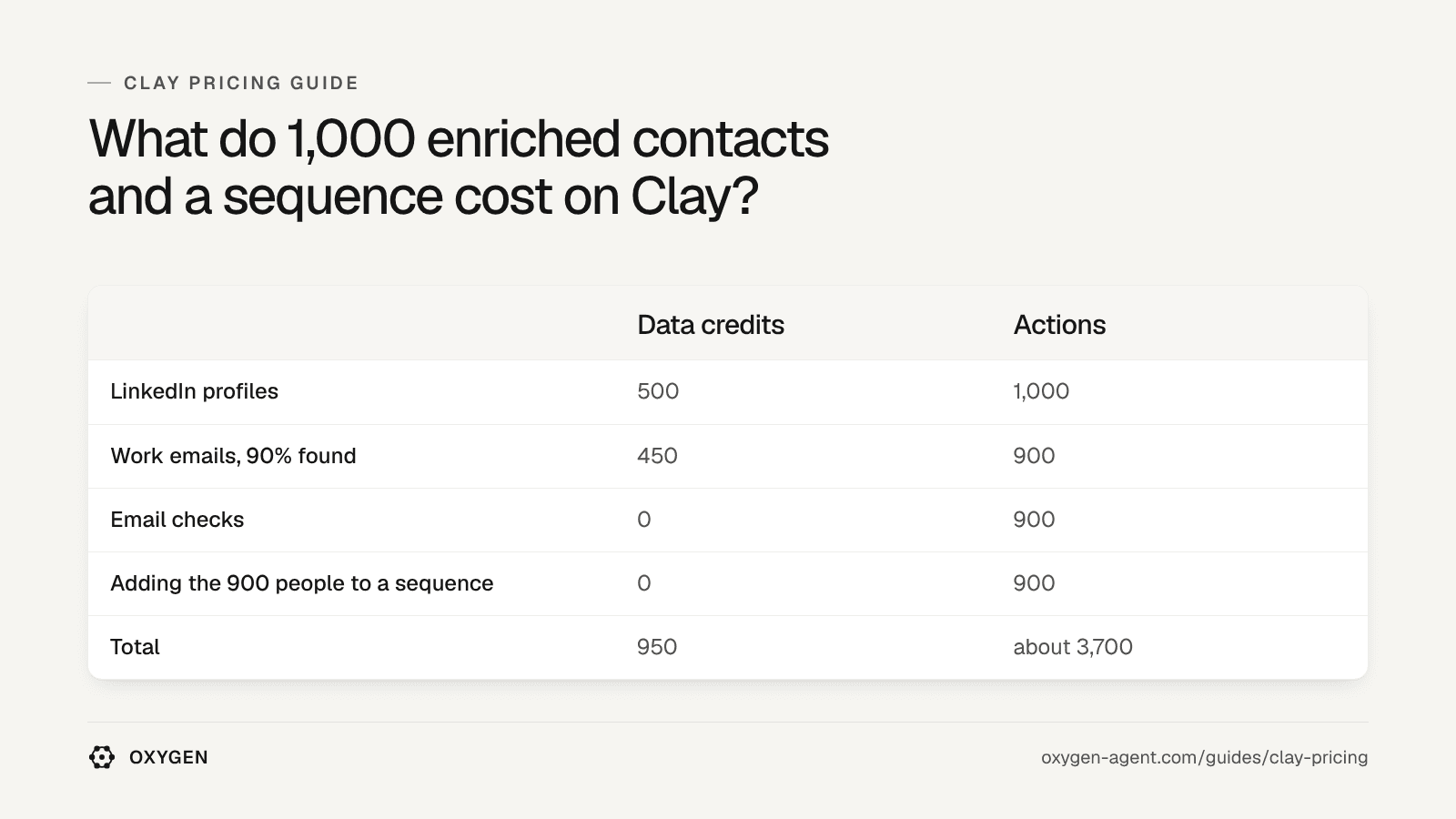
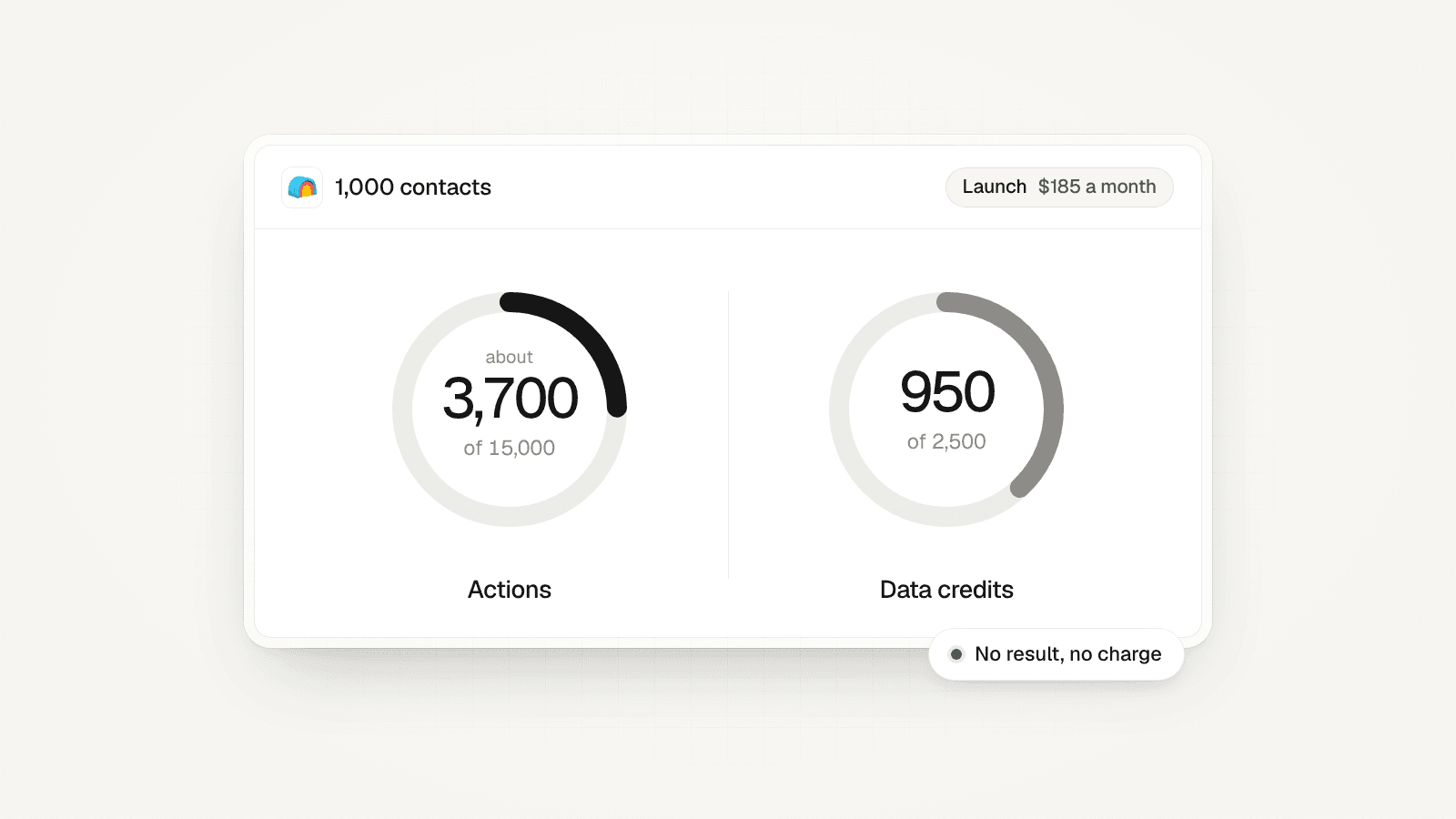
That uses 950 of Launch's 2,500 data credits and about 3,700 of its 15,000 actions. If Clay's own database supplies the people, that search is free too. On Launch you send from mailboxes you connect yourself, such as Google Workspace or Microsoft 365 accounts.
- LinkedIn profiles: 1,000 × 0.5 = 500 credits and 1,000 actions.
- Work emails, 90% found: 900 × 0.5 = 450 credits and 900 actions. The 100 misses cost nothing.
- Email checks with one of Clay's free validators: 0 credits and 900 actions.
- Adding the 900 people to a sequence: 0 credits and 900 actions.
- Total: 950 credits and about 3,700 actions.
Sources: Clay pricing, Clay docs: actions and data credits, Clay docs: connect your own email accounts
What does full enrichment with phone numbers cost?
Full enrichment, with phone numbers, company data and AI fields, costs $350 to $940 a month on Launch for 1,000 records. Clay's docs put a fully enriched record at 6 to 20 credits, so 1,000 records use 6,000 to 20,000 credits a month.
Clay's pricing page sells Launch with 6,000, 10,000 or 20,000 credits, at $290, $460 or $880 a month. Add $60 for actions if the job stays within 15,000 of them; 40,000 actions cost $150. Billed yearly, the same job costs $315 to $846 a month. Clay's own guide sizes Launch for teams enriching under 1,000 records a month and Growth for 1,000 to 10,000.
Sources: Clay pricing, Clay docs: plans and billing
Which Clay costs are easy to miss?
Credit top-ups at a 30% premium, actions that expire each month, and mailboxes and CRM sync that need Growth are the easy ones to miss. Seats are not one of them.
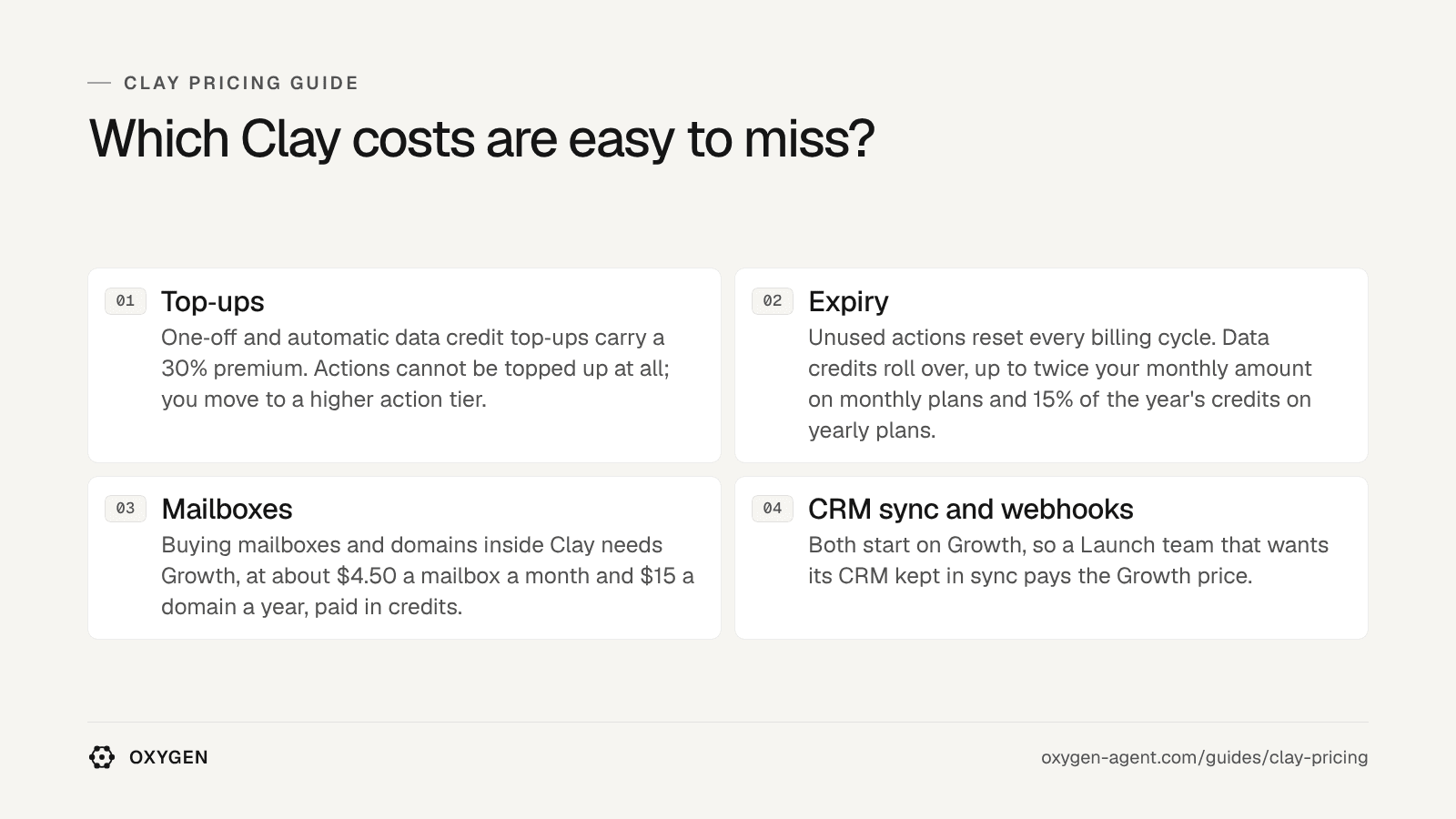
- Top-ups: one-off and automatic data credit top-ups carry a 30% premium. Actions cannot be topped up at all; you move to a higher action tier.
- Expiry: unused actions reset every billing cycle. Data credits roll over, up to twice your monthly amount on monthly plans and 15% of the year's credits on yearly plans.
- Mailboxes: buying mailboxes and domains inside Clay needs Growth, at about $4.50 a mailbox a month and $15 a domain a year, paid in credits.
- CRM sync and webhooks: both start on Growth, so a Launch team that wants its CRM kept in sync pays the Growth price.
Sources: Clay pricing, Clay docs: actions and data credits, Clay docs: buying email accounts
When is Clay worth the price?
Clay is worth it when you need many data sources and custom facts on every row. Its waterfalls try one provider after another until one finds the value. Claygent, its AI agent with web research, fills in custom data points for each row. If someone on your team will own and tune the tables, that flexibility is what you pay for.
It is a weaker fit when you mostly need emails for one sequence a month. Then you pay for two meters and a tool with a learning curve, and most of its depth goes unused.
- Good fit: several data sources per row, AI research columns and a person who likes building tables.
- Good fit: CRM-based workflows on Growth, with sync and webhooks.
- Think twice: email-only outreach to a few hundred people a month.
- Think twice: you already pay a data provider and only need its results in a sheet.
Sources: Clay pricing
How can you pay less for Clay?
Yearly billing saves about 10% on Launch and Growth. Your own data provider keys skip data credits, so Clay charges only actions and the provider bills you directly. Rolled-over credits let a quiet month fund a busy one.
Pick a credit tier that covers your normal month and keep top-ups for spikes, since top-ups cost 30% more. Early-stage startups can apply to Wedge, Clay's startup program, to earn credits.
Sources: Clay pricing, Clay docs: actions and data credits, Clay for startups
What does the same job cost on OXYGEN?
1,000 LinkedIn profiles plus 900 work emails found and checked cost about $92 in credits a month on OXYGEN. The $99 plan's monthly credits cover that. An email lookup that finds nothing costs nothing, and cheaper providers are tried first.
OXYGEN has no people database of its own, so finding the people is extra. Searches run through data providers on credits and show their price before they run. Sending costs nothing per email, and each connected mailbox has a small monthly fee.
Inboxes bought in OXYGEN cost $4 a month with warm-up included. Warm-up means sending a slowly rising number of emails so a new inbox earns trust. Several inboxes share one sending domain, bought at the registrar's price: $12.50 a year for a .com.
LinkedIn steps run in the same sequence at $34 a month per connected account. A free workspace comes with a one-time 250 credits to test enrichment first. Your own provider keys work from the $99 plan.
- 1,000 LinkedIn profiles at about $0.01 each.
- 900 work emails found at about $0.085 each; the misses cost nothing.
- 900 email checks at about $0.00225 each. Where a domain accepts all mail, a second check costs $0.017, assumed for 20% of addresses.
- The CRM, tables, formulas and extra seats: free.
What OXYGEN does not do here
- Fewer data providers than Clay: OXYGEN's waterfalls use up to 17 providers for emails and 13 for phone numbers, some only with your own keys.
- No Salesforce sync; HubSpot syncs both ways.
- Your own provider keys need a paid plan, from $99.
Frequently asked questions
Is Clay free?
Yes. Clay's Free plan includes 500 actions and 100 data credits a month, waterfalls, Claygent and up to 200 rows per table. Its command-line tool (CLI) and API, which let coding agents and your own apps run Clay, work on Free too. It has no phone number lookups, and CRM sync starts on Growth. Clay also offers a 14-day trial of its paid features with 1,000 data credits, without phone numbers.
What is a Clay credit?
Clay uses two units. A data credit pays for data bought from Clay's partners, such as 0.5 credits for an email found. An action pays for the work around it: one per enrichment, AI run or record sent to another tool. Clay says a data credit costs a few cents and an action a fraction of a cent.
Does Clay charge per seat?
No. Every Clay plan, Free included, comes with unlimited seats, and Clay's FAQ says adding people to a workspace is free. You pay per workspace, for the actions and data credits it uses. A team of ten pays the same plan price as a team of one.
Do Clay credits roll over?
Data credits do; actions do not. On monthly Launch and Growth plans, unused data credits build up to twice your monthly amount. Yearly plans carry over up to 15% of the year's credits if you renew on the same or a higher plan. Unused actions expire at the end of each billing cycle.
What happens when you run out of Clay credits?
On Launch and Growth you can buy one-off data credits at a 30% premium or turn on automatic top-ups. Free has no top-ups, and Enterprise buys more at a custom price. For regular use, a bigger credit tier costs less. Actions cannot be topped up. When they run out, you move to a higher action tier.
Is there a Clay discount for startups?
Not on its pricing page, which lists no startup discount. Clay's startup page offers Wedge instead: a two-week program in which venture-backed startups at Series A or earlier earn credits. Clay also runs a partner program for VC firms and accelerators, and yearly billing saves about 10% on Launch and Growth.
Related
Sources
- Clay pricing, checked October 24, 2026
- Clay docs: actions and data credits, checked October 24, 2026
- Clay docs: plans and billing, checked October 24, 2026
- Clay FAQ: adding people to a workspace, checked October 24, 2026
- Clay for startups, checked October 24, 2026
- Clay docs: buying email accounts, checked October 24, 2026
- Clay docs: connect your own email accounts, checked October 24, 2026
- Clay docs: Clay Plugin (API and CLI), checked October 24, 2026
Reviewed October 24, 2026 by Tim Scheuer. OXYGEN's own prices and limits come from the product and its live price list. The other products named here are trademarks of their owners and are not affiliated with OXYGEN. Something out of date? Tell us.