What is a GTM engineer? The job, the stack and when to hire one
Quick answer
A GTM engineer (go-to-market engineer) builds the systems a B2B (business-to-business) sales team runs on. That means a clean customer database (the CRM), tools that find emails and phone numbers, scoring that ranks leads, and automated email and LinkedIn outreach. Sales reps work the leads; the engineer builds the machine that finds, checks and routes them to the right rep. Hire one once you have a proven offer, a sales team and too much manual work.
 By Tim Scheuer, Co-founder of Oxygen · Updated October 26, 2026
GTM engineer meaning: what the job is
A GTM engineer builds and runs the systems behind a company's go-to-market: how it finds buyers, reaches them and wins them. The work sits between sales operations and software. It connects tools, moves data between them and automates steps that reps once did by hand.
Clay, which sells data enrichment (filling in missing emails, phone numbers and company facts) and workflow software, says it coined the role in 2023. It defines GTM engineering as building automated revenue systems with AI, data enrichment and workflow automation. By Clay's count, about 100 new job listings for the role go live every month.
The practice is called GTM engineering, and the person doing it often goes by GTME for short. Despite the title, it is not a software engineering job. Clay says the role builds revenue systems in no-code tools and is measured in pipeline (the sales deals it creates), not shipped code.
Sources: Clay: home page, Clay: GTM engineering, what it is and how to hire, Clay: the complete guide to GTM engineering
What does a GTM engineer do?
Day to day, the job is building and automating workflows, connecting the team's tools and keeping the CRM in shape. Those were the top three duties in Bloomberry's study of about 1,000 job posts for the role.

Clay sorts this work into three rungs: a clean data foundation, then data modeling such as scores, then activation in outreach and routing. Its guide warns that most teams stumble on the first rung.
- Clean data: merge duplicate records, fill in missing fields and set rules for who owns each account.
- Enrichment waterfalls: ask several data providers in turn for an email or phone number until one finds it, then check that it works.
- Scoring: rank accounts and leads by how well they fit and how ready they look, so reps work the best ones first.
- Signals: watch for events such as a new hire, a funding round or a website visit, then start a play (planned outreach steps).
- Outreach: build email and LinkedIn sequences, timed series of messages that stop when someone replies.
- AI agents: research an account before a call, or turn a call recording into CRM notes and a follow-up email.
Sources: Bloomberry: I analyzed 1000 GTM engineering jobs, Clay: GTM engineering, what it is and how to hire, Clay: the complete guide to GTM engineering, OXYGEN notes: GTM engineering cheat sheet
A week in the life of a GTM engineer
In a typical week, a GTM engineer moves from fixing data to shipping outreach: CRM clean-up, a new list, scoring, a sequence, then reporting. Here is a sample week for an in-house engineer at a B2B software company with five sellers.

Each build swaps a manual task for a system that runs on every row. OXYGEN co-founder Tim Scheuer saw the same work at the top agencies he talked to. His five favorite builds there run in Claude Code, Anthropic's AI coding tool. They are CRM hygiene, waterfall enrichment, scrapers for custom signals, dashboards, and agents that research accounts before calls. The week, day by day:
- Monday, CRM hygiene: merge duplicate companies, fill in missing job titles and fix owner rules before the week's outreach.
- Tuesday, a new list: pull target accounts for a new segment, find the buyers and run an email waterfall with verification.
- Wednesday, scoring: add a fit score from company size and tech stack, and a signal score from hiring and website visits.
- Thursday, outreach: ship a sequence for the top-scored leads and test two versions of the first email.
- Friday, reporting and agents: update the reply-rate dashboard and tune the agent that turns call notes into follow-ups.
Sources: Bloomberry: I analyzed 1000 GTM engineering jobs, OXYGEN notes: top 5 Claude Code builds at GTM agencies, Anthropic: Claude Code overview
What skills does a GTM engineer need?
Two kinds of skill matter: knowing how B2B sales works, and enough technical skill to build on it. In Bloomberry's data, 38% of the job posts ask for SQL and 38% ask for Python.
Clay sets a softer bar on code. Its guide says the real signal is a willingness to learn by tinkering. It also looks for people who ask whether a workflow helps close deals, plus curiosity and a habit of testing ideas. Job posts ask for about four years of experience on average.
- Sales sense: know the ideal customer profile (ICP), how deals close and what makes a list worth sending to.
- Data: query the CRM or a data warehouse with SQL, the language for asking a database questions.
- Code: write Python or JavaScript for scrapers, custom connections and API calls (an API lets two tools talk).
- Automation: build flows in no-code tools, and use webhooks, messages one tool sends another when something happens.
- AI: write prompts for AI columns and agents, and check the output on a sample before running thousands of rows.
- Testing: try a play on a small list, count the meetings it books, then scale what works.
Sources: Bloomberry: I analyzed 1000 GTM engineering jobs, Clay: GTM engineering, what it is and how to hire
What tools do GTM engineers use?
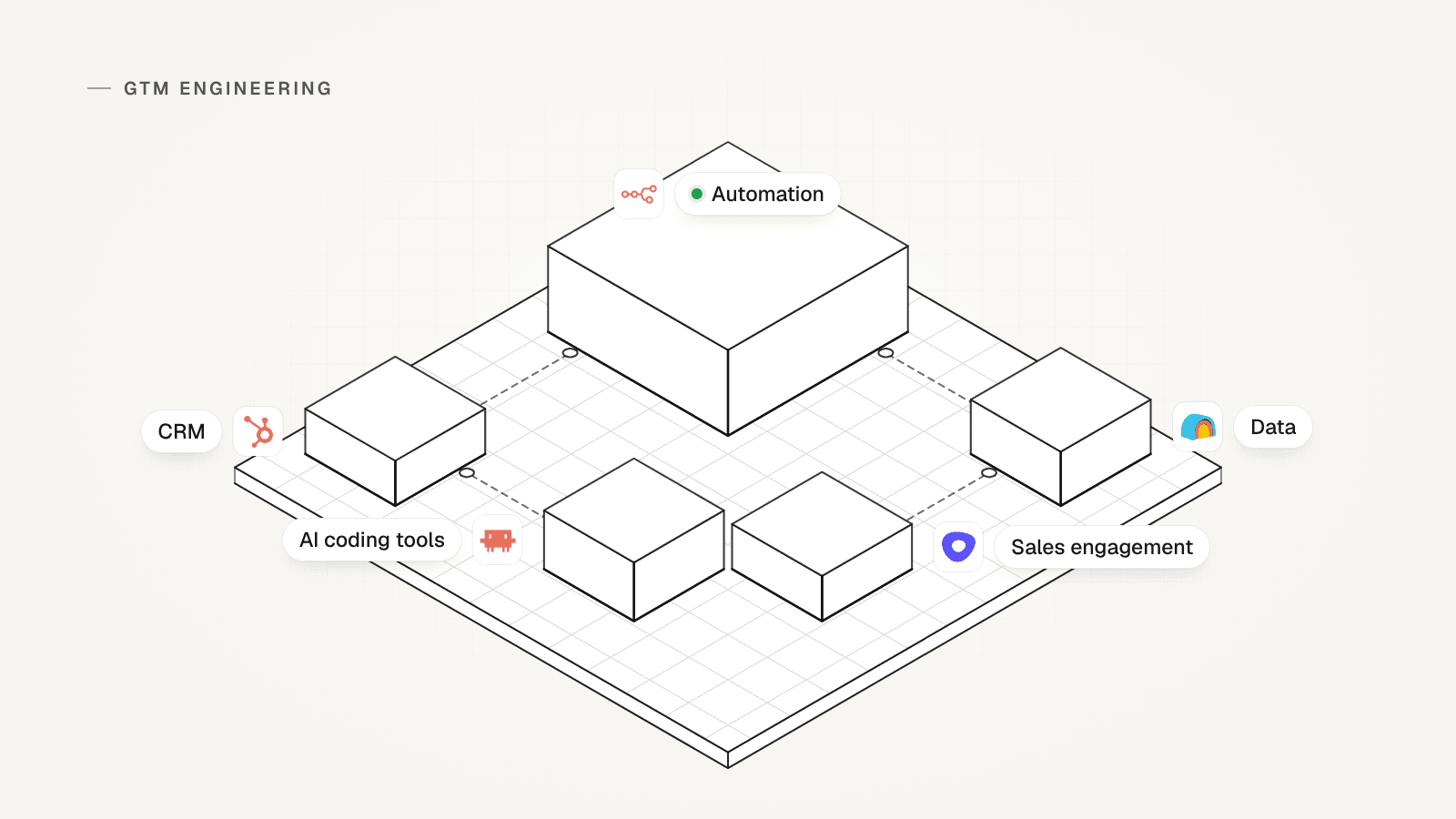
Most GTM engineers work with a CRM, a data tool, an automation tool and a sending tool. Bloomberry counted how often job posts name each one, and Clay came out on top.

Clay also appeared in 90% or more of the 100 LinkedIn profiles of people in the role that Bloomberry checked.
- Data and enrichment: Clay, the most named tool, and Apollo, a database of 240 million contacts, in 29% of posts.
- CRM: HubSpot in 52% of posts and Salesforce in 45%.
- Sales engagement: Outreach, a platform reps use to run and track their outreach, in 49%.
- Automation: Zapier, which connects thousands of apps without code, in 39%, and n8n, a workflow automation platform, in 28%.
- AI coding tools: Claude Code, Anthropic's coding tool, reads files, edits them and runs commands. Every top GTM engineer Tim Scheuer talked to builds their own systems in it.
Sources: Bloomberry: I analyzed 1000 GTM engineering jobs, Clay: home page, Apollo: home page, HubSpot: free CRM software, Salesforce: CRM, Outreach: home page, Zapier: home page, n8n: home page, Anthropic: Claude Code overview, OXYGEN notes: GTM engineering cheat sheet
GTM engineer vs RevOps vs SDR: what is the difference?
RevOps keeps the revenue engine running, an SDR works the leads, and a GTM engineer builds new systems on top. RevOps (revenue operations) lines up sales, marketing and customer success around shared data, processes and goals. An SDR (sales development representative) finds and qualifies new leads and books meetings.
Clay draws the line by output. RevOps delivers a clean CRM, working routing and accurate reports; an SDR delivers booked meetings; a GTM engineer delivers a running system.
In job posts, the line is thinner. Bloomberry found that 9 of the 10 most common duties in these posts also appear in RevOps posts. RevOps posts lead with owning the CRM, and about three in four mention forecast accuracy. Posts for the newer role lead with automation and tool connections, and stress outbound (reaching out to buyers first). Only 1.4% of either kind mention cold calling.
Many companies keep the two together. Clay says most start the role inside RevOps, because RevOps already owns the data, then spread it into growth and customer success.
Sources: HubSpot: what is revenue operations (RevOps)?, Salesforce: what is a sales development representative?, Clay: the complete guide to GTM engineering, Bloomberry: I analyzed 1000 GTM engineering jobs, Clay: GTM engineering, what it is and how to hire
GTM engineer vs RevOps vs SDR at a glance
What each role owns and delivers, from Clay's comparison of the roles, Bloomberry's job post data and the RevOps and SDR definitions from HubSpot and Salesforce.
| Role | What they own | What they deliver |
|---|---|---|
| GTM engineer | Workflows, tool connections and outbound systems | A running system, measured in meetings booked and hours saved |
| RevOps | The CRM, routing, reporting and forecasts | A clean CRM, working routing and accurate reports |
| SDR | Finding and qualifying new leads | Booked meetings from their own activity |
How do you become a GTM engineer?
The most common routes into the role start in sales or operations, not in software. Bloomberry traced the careers in 100 LinkedIn profiles of people in the role.
Nearly all of them taught themselves, and they learned Clay early. Bloomberry's advice: start in a role where you feel the pain of manual work, then build your way out of it. The routes it found, starting with the most common:
- SDR or BDR (reps who book meetings): learn Clay and automation tools to hit targets, build workflows the team uses, then move into the role.
- Sales ops or RevOps: own the CRM, reporting and data quality, then add automation and AI.
- Early startup generalist: wear many hats at a seed or Series A startup and build tools because nobody else will.
- Marketing or growth: start in demand generation, then grow into marketing systems and data.
- Software or data: the rarest route, from engineering into revenue systems.
When should you hire a GTM engineer?
Hire a GTM engineer when the bottleneck is systems, not people. Reps lose hours to research and data entry, the CRM is messy, and every new idea waits on someone technical. Watch for these signs:
- You have a proven offer and a sales team, so there is a working motion to automate.
- Reps spend more time researching accounts and copying data than talking to buyers.
- The CRM has duplicates and missing fields, so reps stop trusting it.
- You send outbound at a volume where saving each rep an hour a day adds up fast.
- Each new play, such as reaching website visitors, waits weeks for someone to build it.
How much does a GTM engineer make?
In job posts that list pay, the median is $127,500 in Bloomberry's study. Cargo's count of 509 US posts from April to July 2026 puts it at $159,000, and at $175,000 for a senior role. Bloomberry's verdict: the role looks like RevOps on paper but pays like engineering.
Location moves the number. In Cargo's data, roles in San Francisco and New York have a $170,000 median, and fully remote roles a $147,500 median.
If a full-time hire is too early, a part-time (fractional) GTM engineer or an agency can build the first systems. Or pick tools that bundle more of the stack, so there is less to glue together.
Sources: Bloomberry: I analyzed 1000 GTM engineering jobs, Cargo: GTM engineer salary, 2026 data, OXYGEN notes: the Forward Deployed GTM Engineer offer
How GTM engineering works in OXYGEN
OXYGEN puts the parts of a GTM engineer's stack in one workspace: data, enrichment, workflows, outreach and the CRM. You can run it from the web app, or from Claude Code, Codex or Cursor. Those connect through its CLI (command line tool) or its MCP server, the standard way AI assistants call outside tools.
A daily CRM clean-up or a weekly list refresh becomes one scheduled workflow. From the CLI or MCP, paid runs need your approval and a credit limit, and a sequence starts only when you approve it. Previews and dry runs (test runs) cost nothing. What the workspace includes:
- Tables you edit like a spreadsheet, with formula, AI and enrichment columns that fill every row.
- Email and phone waterfalls across 17 and 13 providers. Lookups on OXYGEN's credits are charged only when one finds a value.
- Workflows that start on a schedule, a webhook, an API call or one of 80 workspace events. They can include approval steps, and every run is logged.
- Sequences that mix email, LinkedIn, WhatsApp and call steps, and stop a lead who replies on any channel.
- A CRM with companies, people and deals, free on every plan.
- Read-only SQL over your workspace data, for the reports you would write anyway.
What OXYGEN does not do here
- It does not replace judgment: someone still picks the ICP, the scoring rules and what goes out.
- No contact database of its own: lead data comes from data providers, on credits.
- No Salesforce sync; HubSpot syncs both ways, Attio one way, and Pipedrive imports.
- LinkedIn automation carries account risk under LinkedIn's terms. Daily and weekly limits per account lower it; nothing removes it.
- Sending from your own mailbox or LinkedIn account needs a paid plan, from $49 a month.
Frequently asked questions
What does a GTM engineer do?
A GTM engineer builds the systems a sales team runs on. That covers clean CRM data, enrichment, lead scoring, signal-based plays, outreach sequences and AI agents. Job posts name building and automating workflows, connecting tools and owning the CRM as the top three duties.
Is GTM engineering a real job?
Yes. Clay counts about 100 new listings for the role every month, and Bloomberry counted 205% more of these job posts in 2025 than in 2024. Bloomberry adds that much of the work existed before under RevOps; the demand and the pay are what is new.
What skills does a GTM engineer need?
Sales sense first: who to target and how deals close. Then data and build skills: SQL and Python each show up in 38% of job posts, plus no-code automation, APIs and AI prompts. Clay adds curiosity, a focus on closing deals and a habit of testing ideas.
GTM engineer vs RevOps: what is the difference?
RevOps keeps the current revenue engine running: a clean CRM, routing, reports and forecasts. A GTM engineer builds new systems on top, such as automated research or signal-based outreach. The duties overlap a lot, and Clay says most companies place the role inside RevOps first.
What tools do GTM engineers use?
Most use a CRM such as HubSpot or Salesforce and a data tool such as Clay or Apollo. Add an automation tool such as Zapier or n8n and a sending tool such as Outreach. Some also build in AI coding tools such as Claude Code.
Do GTM engineers need to know how to code?
Often, but not always. In Bloomberry's study, 38% of job posts for the role ask for SQL and 38% ask for Python. Clay says a willingness to learn by tinkering matters more than formal training, and most of the people Bloomberry studied taught themselves.
How do you hire a GTM engineer?
Clay looks for hybrids, half commercial thinker and half builder, in Clay communities, RevOps groups and among people who post about their automations. It tests them in three steps: a fuzzy business problem to investigate, a sketch of the system they would build, and a small build challenge.
Related
Sources
- Clay: GTM engineering, what it is and how to hire, checked October 26, 2026
- Clay: the complete guide to GTM engineering, checked October 26, 2026
- Clay: home page, checked October 26, 2026
- Bloomberry: I analyzed 1000 GTM engineering jobs, checked October 26, 2026
- Cargo: GTM engineer salary, 2026 data, checked October 26, 2026
- HubSpot: what is revenue operations (RevOps)?, checked October 26, 2026
- Salesforce: what is a sales development representative?, checked October 26, 2026
- HubSpot: free CRM software, checked October 26, 2026
- Salesforce: CRM, checked October 26, 2026
- Apollo: home page, checked October 26, 2026
- Outreach: home page, checked October 26, 2026
- Zapier: home page, checked October 26, 2026
- n8n: home page, checked October 26, 2026
- Anthropic: Claude Code overview, checked October 26, 2026
- OXYGEN notes: top 5 Claude Code builds at GTM agencies, checked October 26, 2026
- OXYGEN notes: GTM engineering cheat sheet, checked October 26, 2026
- OXYGEN notes: the Forward Deployed GTM Engineer offer, checked October 26, 2026
Updated October 26, 2026. OXYGEN's own prices and limits come from the product and its live price list. The other products named here are trademarks of their owners and are not affiliated with OXYGEN. Something out of date? Tell us.