What is B2B sales? Definition, sales cycle and roles
Quick answer
B2B sales (business-to-business sales) is when one company sells products or services to another company, such as software to a factory. Unlike B2C sales to consumers, a B2B deal needs several people to agree, so it takes longer. Each deal moves through stages, from finding a lead to the close. Often one rep books the meeting, another closes the deal and a third looks after the customer.
 By Tim Scheuer, Co-founder of Oxygen · Reviewed October 23, 2026
B2B sales definition: what does B2B sales mean?
Salesforce answers "What is B2B sales?" in one line: one business sells goods or services to another. B2B stands for business-to-business, so the buyer is a company, not a person shopping for themselves.
Anything sold between two businesses counts, from wood for a cabinet maker to software for a manufacturer.
Sources: Salesforce: what is B2B sales?
B2B vs B2C sales: what is the difference?
The difference is who buys and how they decide. In B2C sales, a business sells to a consumer, who can decide alone and fast. In B2B sales, a group of people at a company decides together.
B2B deals are also larger and built on long-term relationships. A deal can run into the millions of dollars, and buyers keep a product longer, because switching costs time and money.
Sources: Salesforce: what is B2B sales?
B2B vs B2C sales at a glance
The two side by side, row by row. Most of the differences follow from who makes the decision.
| Question | B2B sales | B2C sales |
|---|---|---|
| Who buys | A business, through a group of people from managers up to the C-suite | A consumer, usually alone |
| Deal size | Often large: a deal can run into the millions of dollars | Usually smaller, lower-cost products |
| Time to decide | Long: talks can stretch over several quarters | Short: some buyers decide on impulse |
| Relationship | Long-term, built over many contacts | Short-term transactions |
| Example | A software company sells an inventory tool to a manufacturer | A shopper buys a sweatshirt from an Instagram ad |
Why do B2B deals take so long?
Because more people have to say yes. 6sense finds that typical B2B purchases, averaging about $250,000, involve 10 or more people and take close to a year. Its 2025 survey of nearly 4,000 buyers put the average buying cycle at 10.1 months.
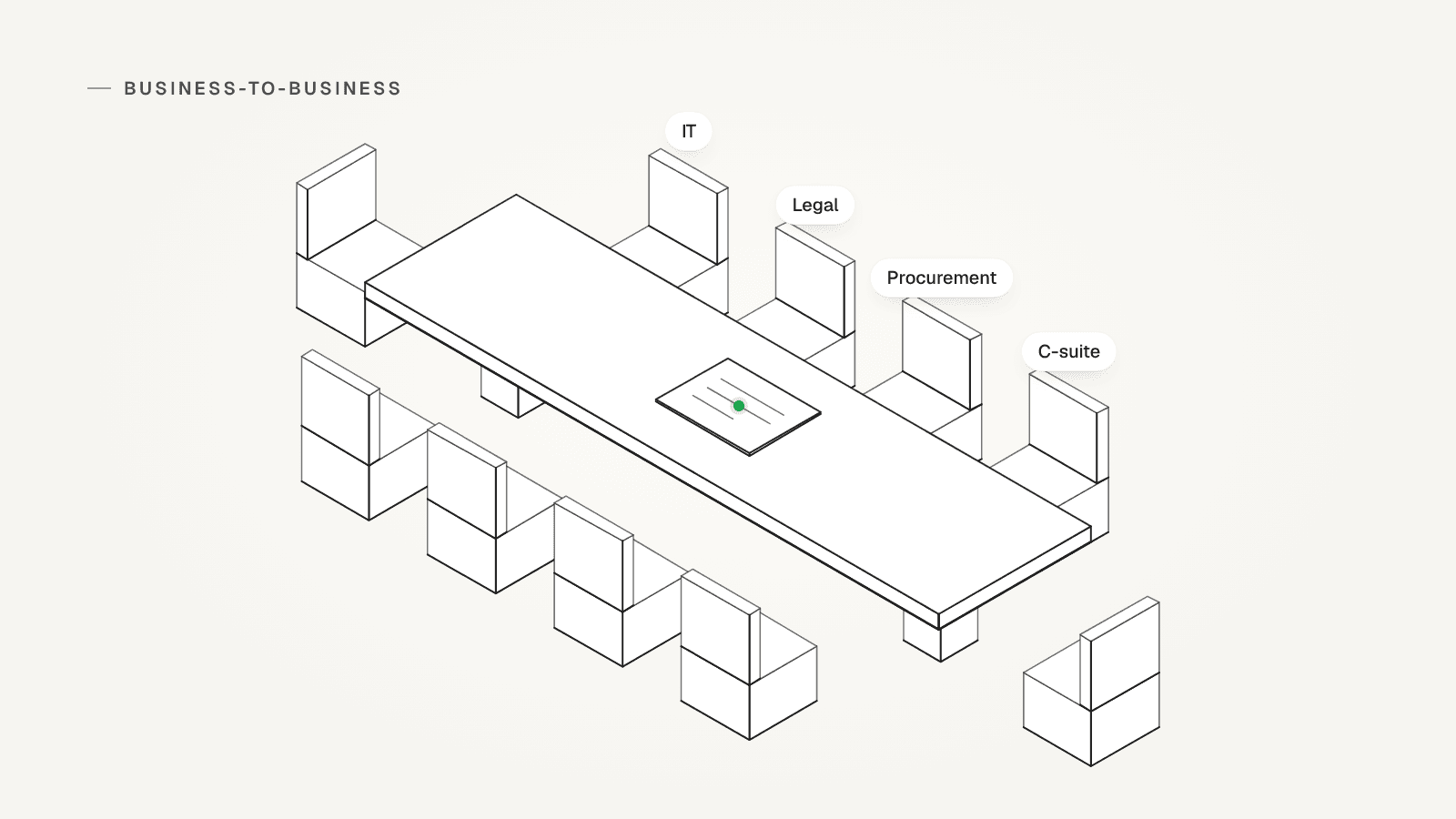
Unless you sell to a small business, expect IT, legal, procurement and senior leaders to join in, each with their own needs.
Buyers also decide a lot before they call you. In 2025, they first contacted a seller 61% of the way through their journey, 6sense found. The vendor they favored by then wins about four deals in five.
Sources: 6sense: 2025 B2B Buyer Experience Report, Salesforce: what is B2B sales?
What are the stages of the B2B sales cycle?
Salesforce lists six core stages: prospecting, qualification, needs assessment, proposal and quote, negotiation and close. HubSpot's seven steps end with following up after the sale and asking for referrals.
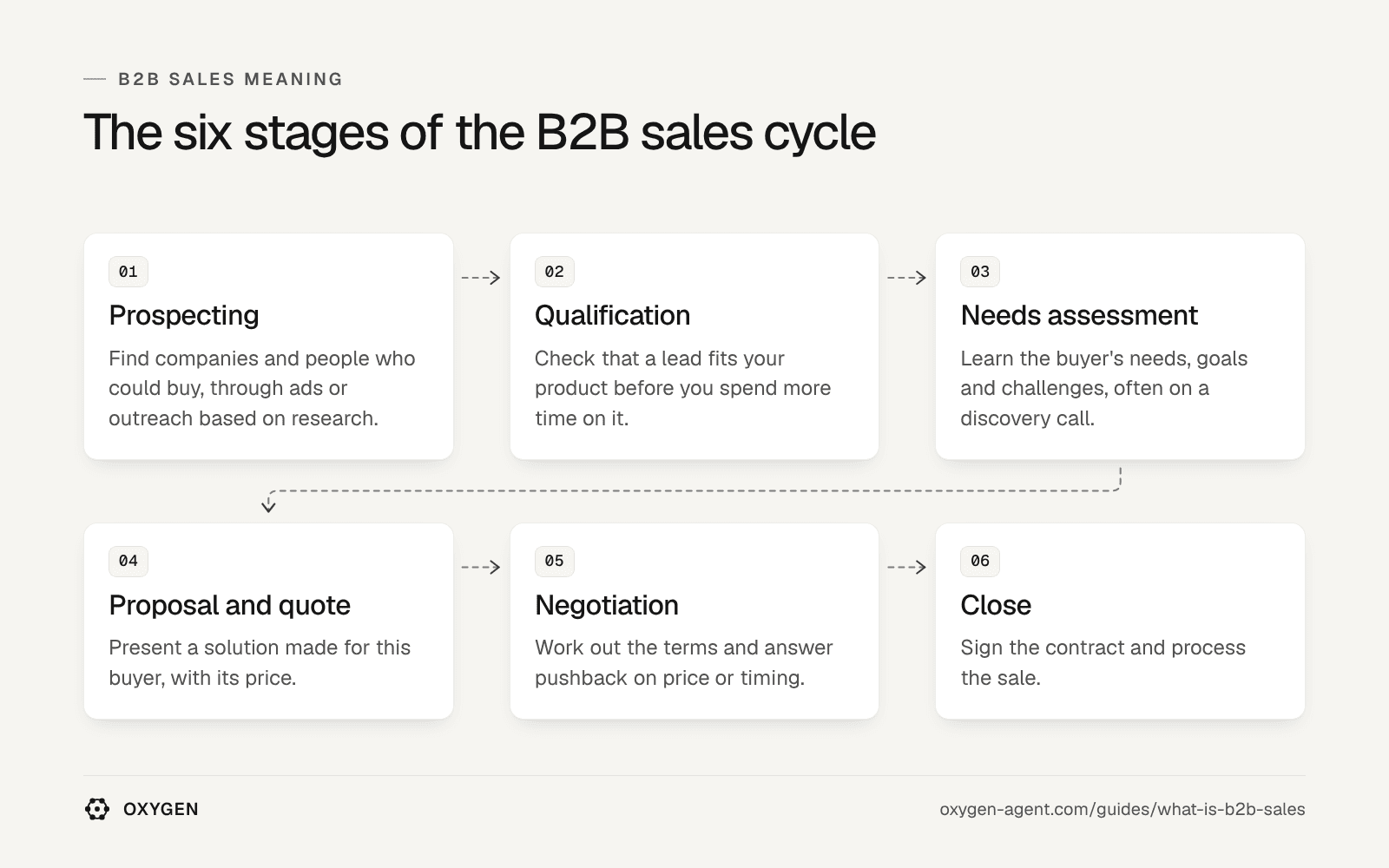
- Prospecting: find companies and people who could buy, through ads or outreach based on research.
- Qualification: check that a lead fits your product before you spend more time on it.
- Needs assessment: learn the buyer's needs, goals and challenges, often on a discovery call.
- Proposal and quote: present a solution made for this buyer, with its price.
- Negotiation: work out the terms and answer pushback on price or timing.
- Close: sign the contract and process the sale.
Sources: Salesforce: what is B2B sales?, HubSpot: the sales cycle and its stages
Who does what in B2B sales? SDR, AE and CSM
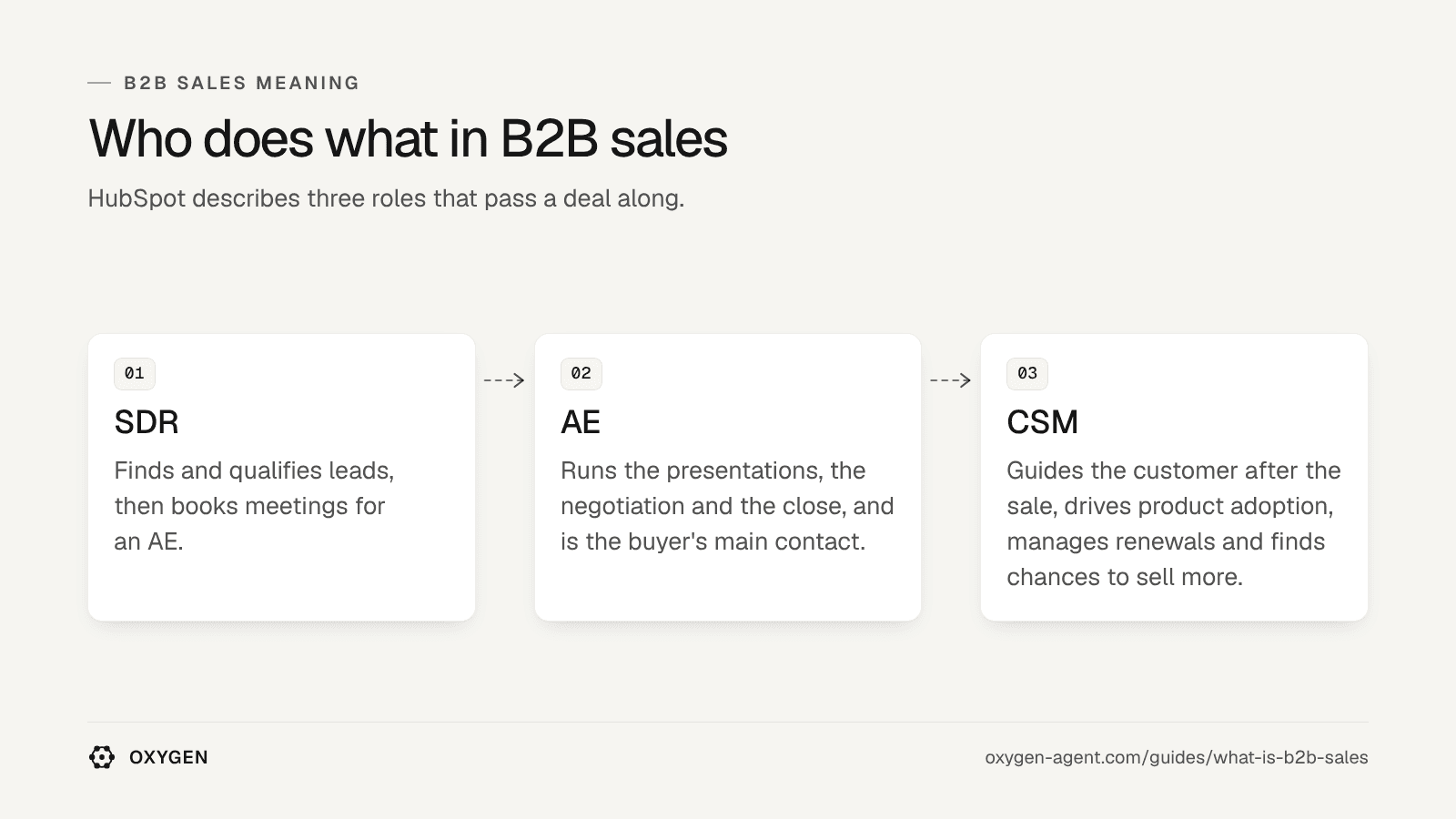
HubSpot describes three roles that pass a deal along. Sales development reps (SDRs) hand warm prospects to account executives (AEs), who work with customer success managers (CSMs) once the deal is signed.
Where teams have SDRs, The Bridge Group's 2025 survey of 351 B2B companies found about one SDR for every 2.4 AEs. On a small team, one person may do all three jobs.
- SDR: finds and qualifies leads, then books meetings for an AE.
- AE: runs the presentations, the negotiation and the close, and is the buyer's main contact.
- CSM: guides the customer after the sale, drives product adoption, manages renewals and finds chances to sell more.
Sources: HubSpot glossary: account executive, Salesforce: what is a sales development representative (SDR)?, HubSpot: what a customer success manager does, The Bridge Group: SDR Models, Motions and Metrics, 2025
Inbound vs outbound B2B sales: which should you use?
Usually both, says Salesforce. The difference is who starts the conversation. With inbound, buyers come to you through search, ads, content or word of mouth. With outbound, a rep reaches out first by email, a cold call or LinkedIn.
Salesforce's rule of thumb: a well-known brand gets steady inbound, while a new company with an unfamiliar product needs more outbound. Outbound also suits complex, high-priced products with a small pool of buyers.
Either way, aim to be known before buyers build their shortlist. In 2025, buyers made the first contact 79% of the time, 6sense found. Most first spoke with the vendor that went on to win.
Sources: Salesforce: inbound vs outbound sales, 6sense: 2025 B2B Buyer Experience Report
How does a B2B sales team work a deal in practice?
In practice, a team turns a list of companies into meetings, then deals, then customers. Here is one deal in OXYGEN, where AI does the research and drafting within the approvals and spending limits you set. Say you sell inventory software to operations leaders at US manufacturers with 50 to 500 employees.
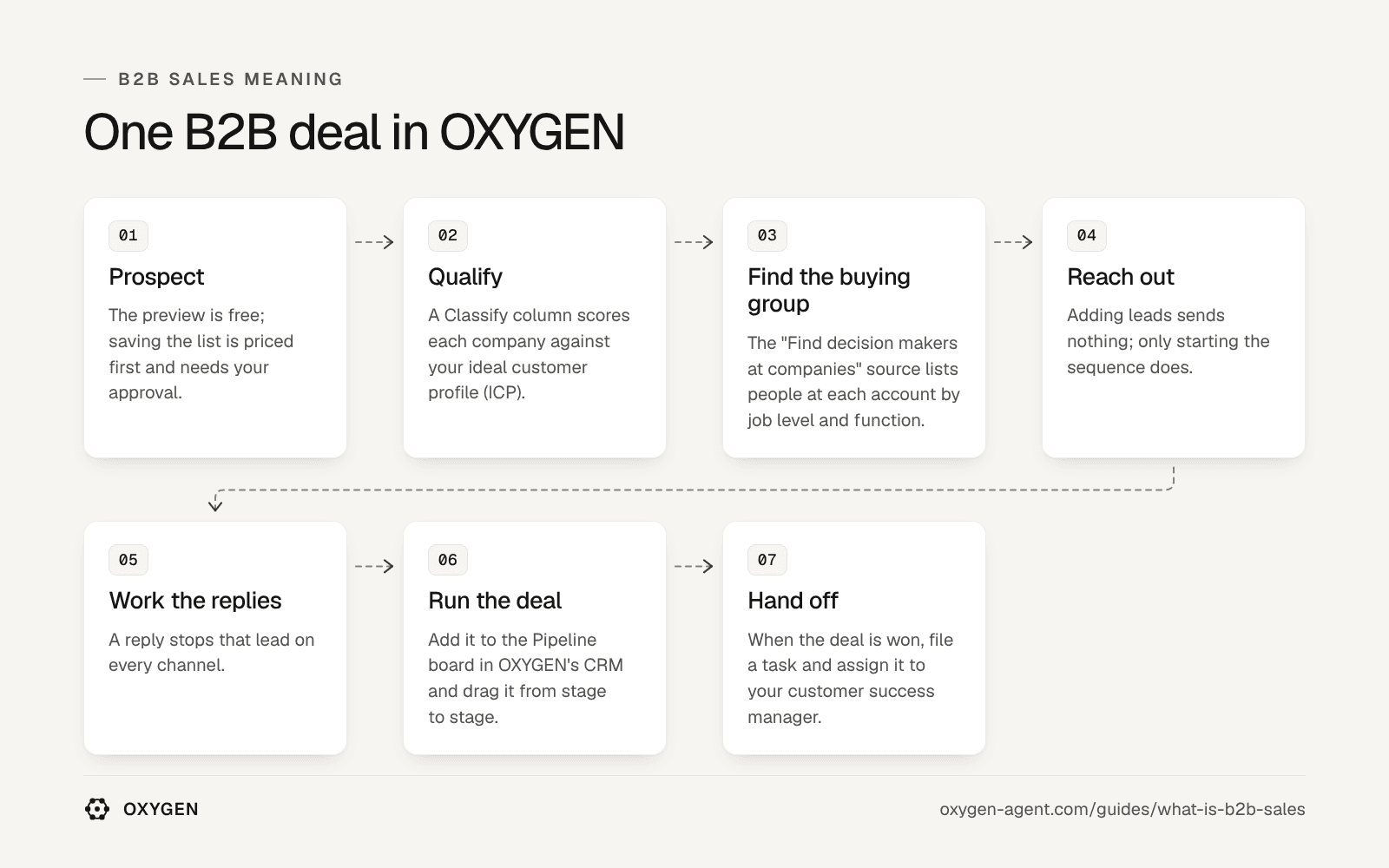
- Prospect: Company Search filters companies by industry, size and location. The preview is free; saving the list is priced first and needs your approval.
- Qualify: a Classify column scores each company against your ideal customer profile (ICP) and gives a reason.
- Find the buying group: the "Find decision makers at companies" source lists people at each account by job level and function. A free sample comes first.
- Reach out: a sequence gives each lead a planned series of emails, LinkedIn messages and call tasks. Adding leads sends nothing; only starting it does.
- Work the replies: replies land in one inbox, Unibox, with an AI label such as Interested. A reply stops that lead on every channel.
- Run the deal: add it to the Pipeline board in OXYGEN's CRM, its database of companies, people and deals. Drag it from stage to stage.
- Hand off: when the deal is won, file a task on it, assign it to your customer success manager and set a deadline.
What mistakes do B2B sales teams make?
Most come from treating a group decision like a quick sale to one person.
- Talking to the wrong people: time spent on managers who cannot make the decision is time lost.
- Rushing the buying group: pushing IT, legal and procurement to move faster than they are comfortable with.
- Sales and marketing working apart: Salesforce names poor coordination between the two as a common challenge.
- Messy CRM data: HubSpot says duplicate records, missing fields and stale lead statuses quietly break sales work.
- Badmouthing rivals: build relationships instead of pushing a hard sell.
Sources: Salesforce: what is B2B sales?, HubSpot glossary: B2B sales
Related terms: buying group, B2C, B2G and more
These terms come up most around B2B sales.
- Buying group: the people at the buying company who have a say in the purchase.
- B2C (business-to-consumer): a business sells directly to a consumer.
- B2G (business-to-government): a business sells to a government agency.
- Account manager: the main contact between the seller and a B2B client.
- Sales engineer: an expert who helps buyers understand the technical side of a product.
Sources: Salesforce: what is B2B sales?
What OXYGEN does not do here
- It does not hold your sales meetings: discovery calls, demos and negotiation stay with your team.
- No contact database of its own: lead data comes from data providers, on credits.
- Calls are in beta: a call task queues the lead for a person to dial in the web softphone.
- No Salesforce sync; HubSpot syncs both ways, Attio one way, and Pipedrive imports.
- The Pipeline board starts with four stages; add your own to match a longer sales cycle.
Frequently asked questions
What is an example of B2B sales?
Salesforce gives several. A lumber company sells wood to a cabinet maker, which builds kitchen cabinets for its customers. A clothing maker sells sweaters to a boutique that resells them. An inventory tool sold to a manufacturer counts too.
What are the types of B2B sales?
Salesforce names four common kinds: manufacturing (supplies and raw materials), retail (goods a business resells), government (B2G) and software as a service (SaaS).
How long is a B2B sales cycle?
Expect months. 6sense's 2025 survey put the average buying cycle at 10.1 months, and HubSpot says enterprise deals often take 6 to 18 months. Track your own, from the first meeting to the signed contract.
What is a B2B sales strategy?
HubSpot defines it as a planned approach to selling to other businesses. A practical one names your buyer personas, outreach sequences and a repeatable sales process, then tracks conversion rates, deal speed and how many customers stay.
Can a small team run B2B sales in OXYGEN?
Yes. A free workspace comes with a one-time grant of 250 credits for lists and research. The CRM, Tables and Knowledge are free to use. Sending from your own mailbox or LinkedIn account needs a paid plan, from $49 a month.
Related
Sources
- Salesforce: what is B2B sales?, checked October 23, 2026
- HubSpot glossary: B2B sales, checked October 23, 2026
- 6sense: 2025 B2B Buyer Experience Report, checked October 23, 2026
- HubSpot: the sales cycle and its stages, checked October 23, 2026
- HubSpot glossary: account executive, checked October 23, 2026
- Salesforce: what is a sales development representative (SDR)?, checked October 23, 2026
- HubSpot: what a customer success manager does, checked October 23, 2026
- The Bridge Group: SDR Models, Motions and Metrics, 2025, checked October 23, 2026
- Salesforce: inbound vs outbound sales, checked October 23, 2026
Reviewed October 23, 2026 by Tim Scheuer. OXYGEN's own prices and limits come from the product and its live price list. The other products named here are trademarks of their owners and are not affiliated with OXYGEN. Something out of date? Tell us.