Define prospecting: what sales prospecting is and how B2B teams do it
Quick answer
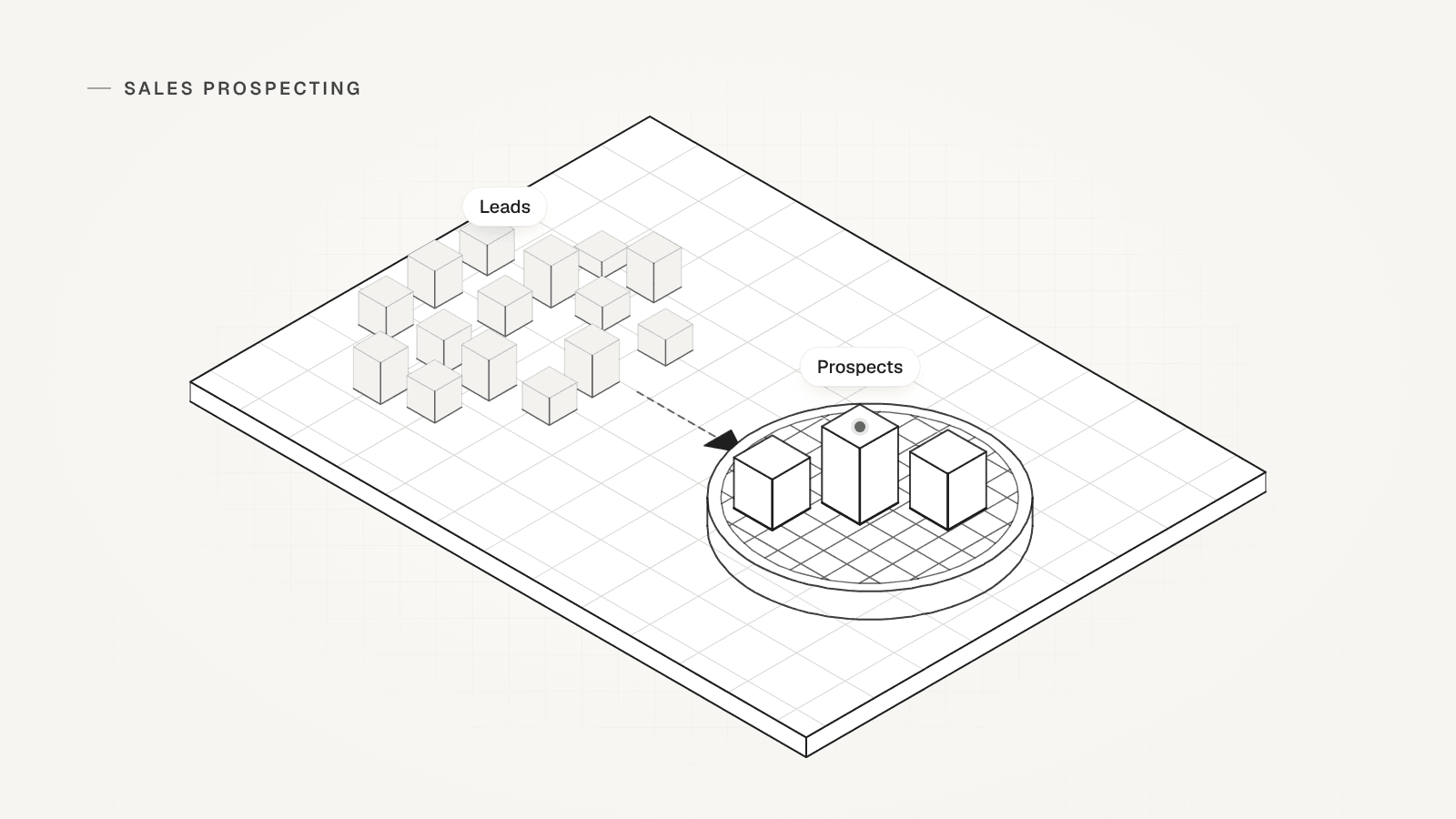
Sales prospecting is finding potential customers, called prospects, and reaching out to start conversations that can become sales. A lead is anyone who has shown interest; a prospect is a lead you have checked for fit. B2B teams, which sell to other businesses, prospect with cold email, calls, LinkedIn and referrals. One warning when you define prospecting: in geology, the word means searching land for minerals or gold.
 By Tim Scheuer, Co-founder of Oxygen · Reviewed October 23, 2026
What is sales prospecting? The meaning of prospecting
Sales prospecting is the start of every sale: finding people who might buy and reaching out to them. HubSpot defines prospecting as "the process of initiating and developing new business by searching for potential customers, clients, or buyers for your products or services."
Salesforce puts it in one line: prospects are potential customers, and prospecting is the process of finding them.
In geology, prospecting means the search for minerals, fossils or precious metals, such as gold. Sales prospecting works the same way: you sift a big market for the few buyers worth your time.
Sources: HubSpot: sales prospecting skills, tips and techniques, Salesforce: sales prospecting, how to find right-fit customers, Wikipedia: prospecting
What is a prospect? Prospect vs lead
A prospect is a potential customer you have checked for fit. A lead is anyone who has shown some interest, such as downloading a guide or joining a webinar, but has not been checked yet.
HubSpot's guide sums it up: "A lead is a name. A prospect is a possibility." Its example: a high school student who downloads your ebook is a lead. An operations director at a 500-person logistics firm who opened three of your emails is a prospect.
In HubSpot's guide, a lead becomes a prospect after three checks: the company fits, the need is real, and someone there can decide. Salesforce also calls leads "unqualified prospects," so agree on one meaning before you count either.
Sources: HubSpot: sales prospecting skills, tips and techniques, HubSpot: lead vs. prospect vs. sales opportunity, Salesforce: sales prospecting, how to find right-fit customers
Lead vs prospect vs sales opportunity at a glance
HubSpot's three stages, from first interest to an active deal. Prospecting is the work in the middle: research and qualify.
| Stage | What it means | How people get there | Sales work |
|---|---|---|---|
| Lead | Showed initial interest, not yet checked for fit | An inbound form, a content download, cold outreach or an event | Identify and capture |
| Prospect | A lead confirmed as a fit against your qualification criteria | Passes qualification: company fit, a real need and a decision-maker | Research and qualify |
| Sales opportunity | A qualified prospect actively considering a purchase | Agrees to evaluate your product | Nurture and close |
Why does sales prospecting matter for B2B teams?
Prospecting keeps the pipeline, the list of deals a team is working on, full of new chances to sell. Buyers are open to it: RAIN Group found that 82% of buyers accept meetings with sellers who reach out to them.
Good prospecting also saves money. Every name costs time to research and money to find an email for. A short list of strong prospects beats a long list of names.
What are the main sales prospecting methods?
The main methods are cold email, cold calling, social selling, referrals, inbound follow-up and trigger events. Outbound methods start with the seller; inbound ones start with a buyer who has already shown interest. HubSpot says reps can mix both.
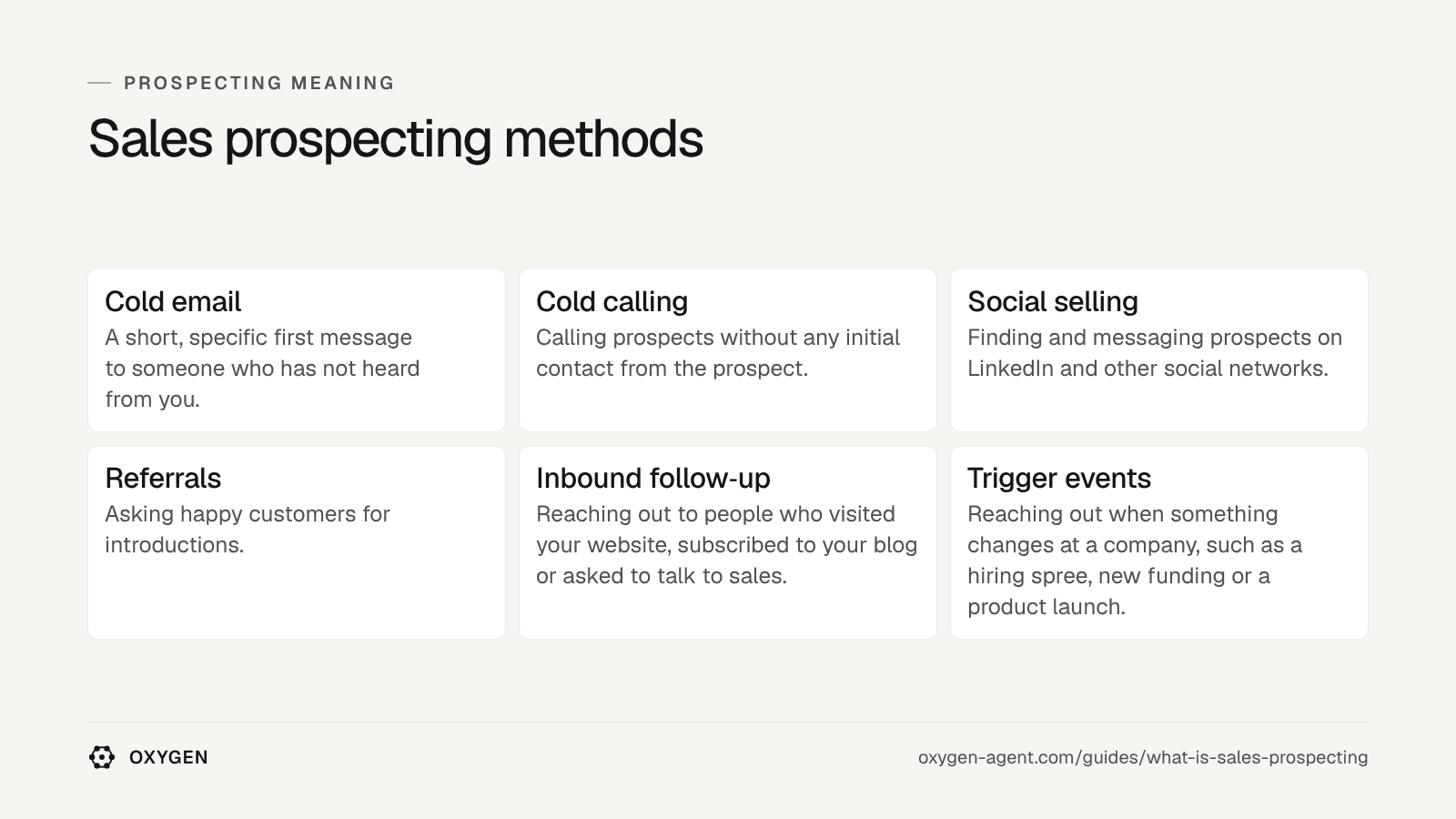
- Cold email: a short, specific first message to someone who has not heard from you, with a few follow-ups.
- Cold calling: in Salesforce's words, calling prospects without any initial contact from the prospect.
- Social selling: finding and messaging prospects on LinkedIn and other social networks.
- Referrals: asking happy customers for introductions. In HubSpot's survey of over 1,000 sales pros, 66% said referrals from existing customers offer the best leads.
- Inbound follow-up: reaching out to people who visited your website, subscribed to your blog or asked to talk to sales.
- Trigger events: reaching out when something changes at a company, such as a hiring spree, new funding or a product launch.
Sources: HubSpot: sales prospecting skills, tips and techniques, Salesforce: sales prospecting, how to find right-fit customers
How do you build a prospecting list? A worked example
Turn your ideal customer profile (ICP) into a list of companies, find the right people there, then check each one before outreach. Here is that work in OXYGEN's Tables, where each paid step shows its price before anything runs.
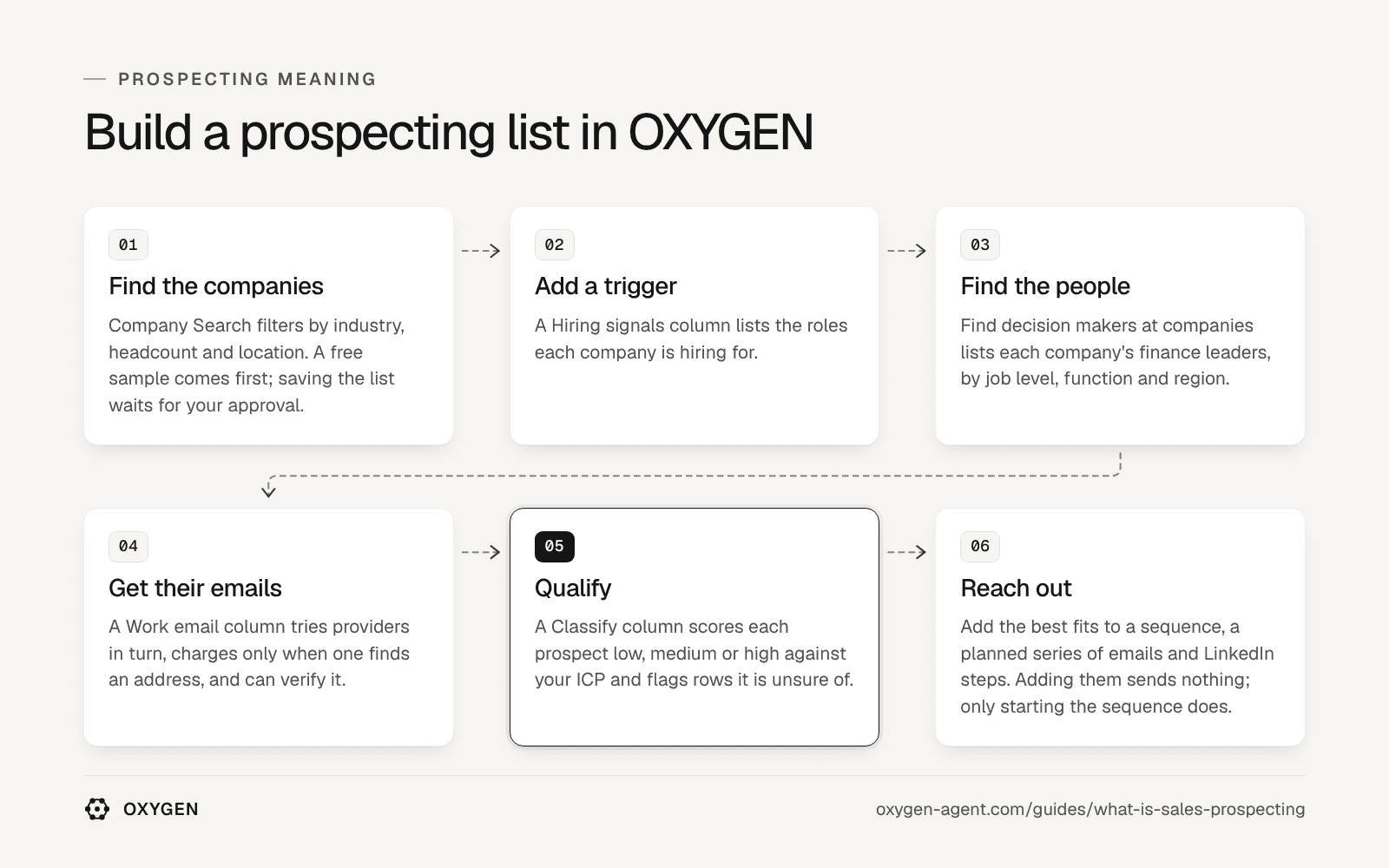
Say you sell expense software to finance leaders at US construction companies with 100 to 1,000 employees.
- Find the companies: Company Search filters by industry, headcount and location. A free sample comes first; saving the list waits for your approval.
- Add a trigger: a Hiring signals column lists the roles each company is hiring for.
- Find the people: Find decision makers at companies lists each company's finance leaders, by job level, function and region.
- Get their emails: a Work email column tries providers in turn, charges only when one finds an address, and can verify it.
- Qualify: a Classify column scores each prospect low, medium or high against your ICP and flags rows it is unsure of.
- Reach out: add the best fits to a sequence, a planned series of emails and LinkedIn steps. Adding them sends nothing; only starting the sequence does.
What mistakes do teams make when prospecting?
Most mistakes are about the list or the follow-up: counting every lead as a prospect, blasting untargeted lists and quitting good fits too soon.
- Calling every lead a prospect: check company fit, a real need and who decides before anyone counts as pipeline.
- Spray and pray: sending one generic message to a big, untargeted list. HubSpot's guide warns that effective prospecting "isn't about spray-and-pray lists or robotic outreach."
- Giving up on good fits too soon: RAIN Group puts the average at 8 touches (emails, calls or messages) to get a meeting.
- Chasing poor fits: after five touches with a low-fit prospect, HubSpot's guide says, "you're not prospecting, you're procrastinating."
- Ignoring spam reports: Google tells senders to keep reported spam below 0.1% and never reach 0.3%.
- Skipping the do-not-contact check: take out customers, open deals and anyone who opted out before a list goes live.
Sources: HubSpot: sales prospecting skills, tips and techniques, RAIN Group: 114 essential sales statistics, Google: email sender guidelines
Related terms: lead, ICP, SDR and more
Prospecting sits between lead generation and closing a deal, so these five terms come up with it.
- Lead: anyone who has shown some interest in what you sell, before anyone checks their fit.
- Sales opportunity: in HubSpot's words, a qualified prospect who is actively considering a purchase.
- ICP (ideal customer profile): the kind of company most likely to buy, used to choose who to prospect.
- SDR (sales development representative): the rep whose job is prospecting, qualifying leads and booking meetings.
- Sequence or cadence: a planned series of emails, calls and LinkedIn messages to one prospect that stops when they reply.
What OXYGEN does not do here
- No contact database of its own: company and people data come from data providers, on credits.
- Find decision makers at companies needs a column with each company's LinkedIn URL.
- A fit score judges only the data in the row. It flags the rows it is unsure of, but check rows with missing facts too.
- Sending needs a connected mailbox or LinkedIn account, and connecting one needs a paid plan.
- A sequence that is already running contacts newly added leads on its next send, under the approval you gave at launch.
Frequently asked questions
What is a prospect?
A prospect is a potential customer you have checked for fit: the right kind of company, a real need and someone who can decide. HubSpot calls a prospect "a lead that's been qualified." A lead is anyone who has shown interest but has not been checked yet.
What is prospecting?
In sales, prospecting is finding people who might buy and getting in touch with them, so a first talk can turn into a sale. Teams research who fits, find contact details, reach out by email, phone or LinkedIn, and qualify the people who answer.
What is the meaning of prospecting?
Prospecting has two common meanings. In sales, it means finding and contacting potential customers. In geology and mining, it means searching land for minerals, fossils or precious metals, such as gold. On a sales team, it always means the first.
What is the difference between prospecting and lead generation?
HubSpot draws the line this way: lead generation fills the funnel by attracting contacts at scale through marketing, and prospecting filters it. Prospecting also reaches beyond existing leads, to people who have not shown any interest yet.
How many touches does it take to book a meeting?
RAIN Group puts the average at 8 touches to generate a meeting with a buyer. Spread them over a few weeks and across email, phone and LinkedIn, and stop sooner with prospects who are a poor fit.
Can I build a prospecting list in OXYGEN for free?
Yes. Company Search shows a free sample before you buy. A free workspace also comes with a one-time grant of 250 credits for companies, people and emails. Sending from your own mailbox or LinkedIn account needs a paid plan, from $49 a month.
Related
Sources
- HubSpot: sales prospecting skills, tips and techniques, checked October 23, 2026
- HubSpot: lead vs. prospect vs. sales opportunity, checked October 23, 2026
- Salesforce: sales prospecting, how to find right-fit customers, checked October 23, 2026
- RAIN Group: 114 essential sales statistics, checked October 23, 2026
- Google: email sender guidelines, checked October 23, 2026
- Wikipedia: prospecting, checked October 23, 2026
Reviewed October 23, 2026 by Tim Scheuer. OXYGEN's own prices and limits come from the product and its live price list. The other products named here are trademarks of their owners and are not affiliated with OXYGEN. Something out of date? Tell us.