Inbound vs outbound: the difference, when each wins, and the hybrid
Quick answer
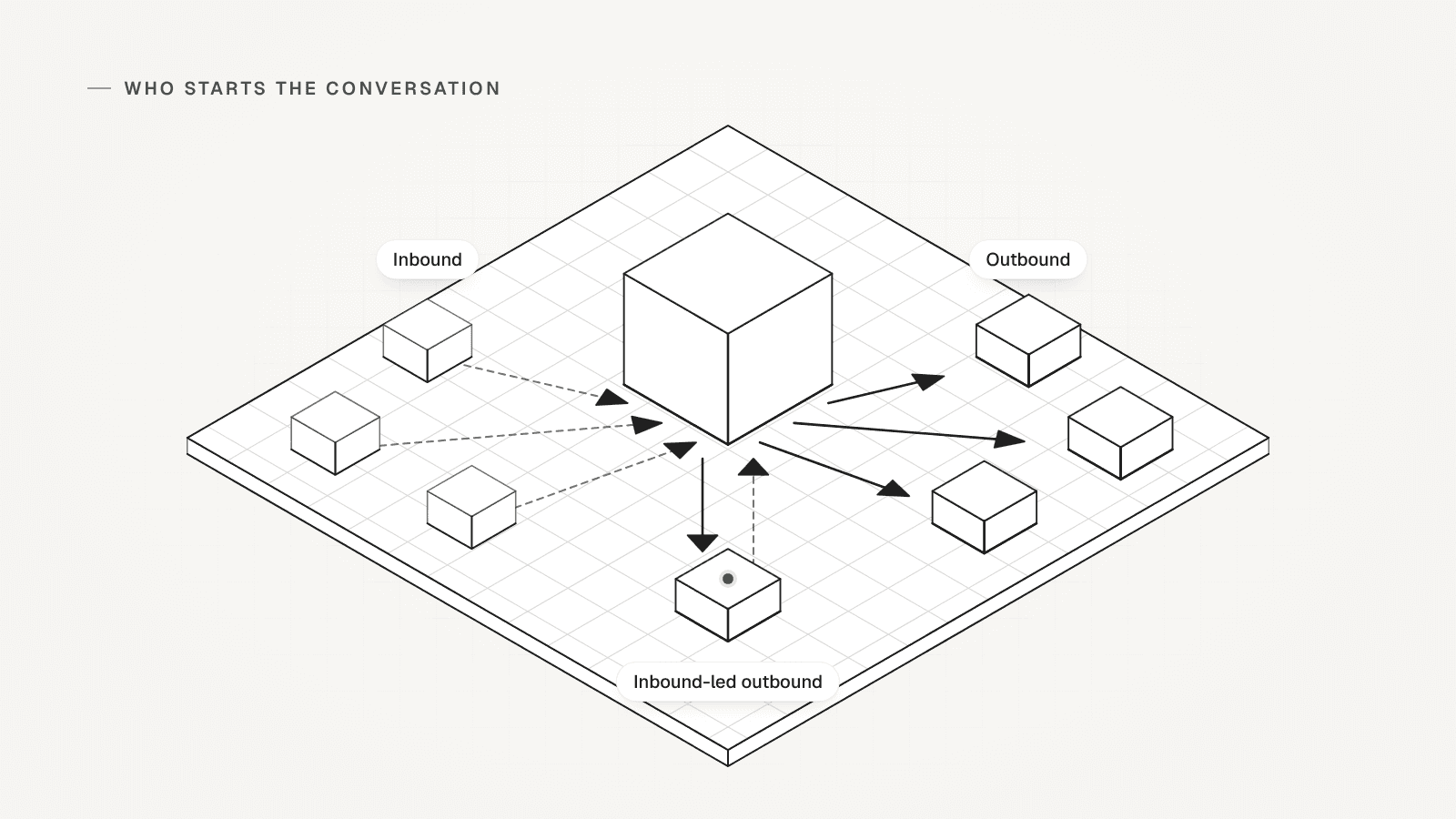
Inbound vs outbound comes down to who starts the conversation. With inbound, the buyer finds you through search, content, ads or a referral. With outbound, you reach out first by email, phone or LinkedIn. Outbound suits large deals and a short list of buyers you can name. Inbound suits markets that search for what you sell. Most B2B SaaS companies, which sell software to other businesses, need both. Inbound-led outbound links them: contacting people who already engaged.
 By Tim Scheuer, Co-founder of Oxygen · Updated October 26, 2026
What is the difference between inbound and outbound sales, marketing and leads?
The difference is who starts the conversation: the buyer or you. Salesforce calls this the biggest difference between inbound and outbound sales. With inbound, buyers come to you after a web search, an ad or word of mouth. With outbound, a rep contacts people who may not know your company yet.
Marketing splits the same way. HubSpot describes inbound marketing as earning attention with content people want: blog posts, search, social media, email and video. Outbound marketing puts a message in front of people who may not be searching. Think cold calls, direct mail, TV, display ads or bought email lists.
Leads follow the same rule. An inbound lead contacted you first: they filled in a form, booked a demo or signed up. An outbound lead is someone your team contacted first. Woodpecker notes the two are at different stages of buying.
Beyond sales and marketing, the words keep their direction. An inbound call comes in to a company, and an outbound call goes out from it.
Sources: Salesforce: inbound vs outbound sales, HubSpot: what is inbound marketing?, Woodpecker: the difference between inbound and outbound (2026)
Inbound vs outbound at a glance
The two motions side by side, on the questions that decide a plan. Each row comes from the sources listed under the table.
| Question | Inbound | Outbound |
|---|---|---|
| Who starts it | The buyer, after a search, an ad, a post or a friend's tip | You, with an email, a call or a LinkedIn message |
| Main channels | Blog posts, search, social media, newsletters and video | Cold email, cold calls, LinkedIn messages, direct mail and events |
| Who you reach | People already looking for an answer | People you pick, whether or not they are looking yet |
| Time to first results | Slow: Google says some search changes take several months to show | Fast: a cold email campaign can start within days |
| Ongoing work | A page that ranks keeps working after you publish it | Each campaign needs fresh lists and steady management |
| Best fit | Products many people search for, smaller deals, a known brand | New or complex products, a small pool of buyers, high-priced deals |
| Main risk | Months of work before leads arrive, and less say in who shows up | Badly aimed sends draw spam reports, and a high spam rate sends more of your email to spam |
When does outbound win?
Outbound wins when you can name your buyers and each deal is worth a rep's time. Salesforce's checklist points the same way. It says outbound works well with a small pool of buyers, a product that takes explaining and high-priced B2B sales. It also suits new or niche products that buyers may not know they need.
Speed is the other reason. Woodpecker, a cold email tool, says a campaign can start within days. You need a list, a sending tool and a clear ICP (ideal customer profile). Organic search is slower: Google says some changes take several months to show. Woodpecker adds that for early-stage teams, outbound shows faster which message works and who buys.
Sources: Salesforce: inbound vs outbound sales, Woodpecker: the difference between inbound and outbound (2026), Google Search Central: SEO starter guide
When does inbound win?
Inbound wins when many buyers already search for what you sell, and each deal is too small for a rep to chase. Salesforce lists products that many people search for online and services with an existing audience. It also warns that a low average sale may not justify spending on outbound.
Christoph Janz, a partner at Point Nine Capital, made the math concrete in 2014. In his example, a SaaS company selling to small businesses for about $1k a year can spend $675 to win a customer. At that price, he wrote, cold calling usually doesn't work, and inbound marketing is the closest thing to a silver bullet.
Compare that with the cost of a meeting from a rep. The Bridge Group's 2025 survey puts the median on-target pay of an SDR, or sales development rep, at $80k a year. That is base pay plus commission at quota. The median quota is 10 held meetings a month. That is about $670 of pay per meeting at quota, close to Janz's whole budget for one customer.
Inbound also keeps paying. Woodpecker notes that a ranking blog post works while you sleep, while a cold email campaign needs constant list refreshing.
Sources: Salesforce: inbound vs outbound sales, Christoph Janz: five ways to build a $100 million business (2014), The Bridge Group: SDR Models, Motions and Metrics, 2025, Woodpecker: the difference between inbound and outbound (2026)
Inbound or outbound first? A decision table by deal size and market
Small deals, buyers who search: lead with inbound. Big deals, a short list of buyers: lead with outbound. To place yourself, start with what one customer pays you a year, your ACV (annual contract value), then count your buyers. The picks add Salesforce's questions: how many buyers there are, and how hard the product is to explain. If two rows describe you, let the deal size decide, since it sets what one sale can pay for.

- ACV around $1k, thousands of small buyers: lead with inbound and self-serve sign-up. Janz says cold calling usually doesn't work at this price.
- ACV around $10k: lead with inbound, plus reps who also prospect. Janz says $10k rarely pays for field reps who travel to buyers. Inside sales reps, who work by phone and email, can close leads and find new ones.
- ACV of $100k or more, a short list of buyers: lead with outbound to a named list. Janz counts 1,000 such customers for $100 million a year, and Salesforce ties outbound to a small pool of buyers.
- A market that searches for your category: lead with inbound, because buyers come looking.
- A new category nobody searches for yet: lead with outbound, then content. Write about the questions buyers ask on your calls.
- New deals needed this quarter: lead with outbound, since a campaign can start within days.
Sources: Christoph Janz: five ways to build a $100 million business (2014), Salesforce: inbound vs outbound sales, Woodpecker: the difference between inbound and outbound (2026)
What is inbound-led outbound?
Inbound-led outbound means reaching out first to people who showed interest but never asked to talk. They liked your post, viewed your profile, visited your pricing page or downloaded a guide. Woodpecker says emails to people who already interacted with your brand get significantly higher reply rates than pure cold lists.

OXYGEN co-founder Tim Scheuer described the team's routine in a June 2026 note. Each day it pulls everyone who engaged with its LinkedIn posts and scores them against the ICP. A person reviews the list before anything goes out, and each message names the post. He wrote that 75% of OXYGEN's customers came in through these post-engager flows, not cold lists.
Here is the same motion in OXYGEN, from the first signal, such as a like or a profile view, to the reply. Credits are OXYGEN's usage currency.
- Catch the engagers: a Post Engagers table watches up to 10 LinkedIn profiles, your team's, a partner's or a competitor's. It adds the people who react to or comment on their posts, with their employer.
- Add your own signals: Profile Viewers and Connections & Followers tables read your connected LinkedIn accounts for no credits. Looking up each new viewer's profile costs credits; the app ticks it by default.
- Bring in the site: each visitor that RB2B, a website visitor tool, reveals becomes a website visit signal. A Webhook table gives your form a web address to post to, and turns each form fill into a row.
- Score the fit: a Classify column rates each person against your ICP as low, medium or high, with a reason.
- Pick who to contact: filter each table to the people rated high. The oxygen signals leads-today command also ranks recent signals on people in your CRM, the system that holds your contacts and deals.
- Reach out: enroll the people who fit in a sequence, a planned series of emails and LinkedIn messages. Open with what they engaged with. A reply stops that lead in the sequence.
- Let it run: autoenroll adds a LinkedIn sender's new connections, followers, viewers and post engagers to a sequence, under caps you approve. It skips the fit score, so pick a sequence that suits anyone who engages.
- Keep your do-not-contact list current: autoenroll never enrolls anyone on it, and a sequence skips them too.
Sources: Woodpecker: the difference between inbound and outbound (2026), Tim Scheuer: inbound-led outbound with post engagers (June 2026), RB2B: website visitor identification
How do B2B teams combine inbound and outbound?
Teams combine them by letting each feed the other. Woodpecker says most B2B companies need both. Salesforce's example is a blog that pulls in readers while reps find good-fit prospects on social media and contact them.
- Outbound tests the message: the openers that get replies become blog posts and pages, as Woodpecker suggests.
- Inbound feeds outbound: people who engage but don't book a call become your warmest list.
- One CRM, one owner: keep every lead in one CRM with one owner. Then two teams never write to the same person.
- Fast answers: reply to form fills and demo requests the same day, while the buyer is still looking.
- Big accounts by name: point outbound at the large accounts that never fill in a form.
- One scoreboard: judge both on pipeline (the open deals they create), won deals and the cost to win a customer, split by source.
Sources: Salesforce: inbound vs outbound sales, Woodpecker: the difference between inbound and outbound (2026)
Which metrics should you track for inbound and outbound?
Track reply rate and meetings held for outbound, and sign-ups and demo requests for inbound. Judge both on the same late numbers: pipeline and won revenue. The benchmarks below come from named reports.
- Inbound: visits from search, the share of visitors who sign up or ask for a demo, and how fast a rep answers each request.
- Outbound: bounce rate (emails that fail to arrive), spam complaints, reply rate, positive replies and meetings held per 100 people contacted.
- Reply rate benchmark: Hunter's 2026 report on 31 million emails found a 4.5% average reply rate, and 3% for sales outreach.
- Bounce benchmark: the same report found a 3.6% average bounce rate. OXYGEN's bounce protection warns above 2% and can pause a sequence above 3%.
- Spam line: Google asks senders to keep their spam rate below 0.1% and never reach 0.3%.
- Both: pipeline created, win rate, time to close and the cost to win a customer, split by source.
- In OXYGEN: the GTM (go-to-market) Command Center at /dashboards counts touches, replies, positive replies, meetings, new deals and won deals over 7 to 30 days. Its rates are a rough guide.
Sources: Hunter: State of Email Outreach 2026 report, Google: email sender guidelines
Is outbound dead?
No. Outbound still books meetings when it is aimed well. RAIN Group found that 82% of buyers accept meetings with sellers who reach out to them. In Hunter's 2026 survey, 58% of decision makers get a useful cold email at least once a month.
What works less is the mass blast to a bought list. In Hunter's data, sequences sent to 21 to 50 people drew a 6.2% reply rate, against 2.4% for those sent to over 500. Hunter's verdict: cold email is not dead, but it is split between campaigns that feel relevant and those that don't.
Buyers' channels are shifting too. Hunter found that 50.5% of decision makers now prefer LinkedIn for outreach, against 25% for email. So a good outbound plan mixes email and LinkedIn, and aims both at people who fit.
Sources: RAIN Group: 114 essential sales statistics (updated July 2025), Hunter: State of Email Outreach 2026 report
What OXYGEN does not do here
- It does not host your website, blog or forms, or track your search rankings. It picks up once someone engages: a reaction, a profile view, a visitor reveal or a form sent to a webhook.
- No contact database of its own: emails and phone numbers come from data providers, on credits, and some people have none to find.
- The Post Engagers table is not free: each daily run spends credits within the cap you approve, and it reads posts from the last seven days.
- LinkedIn hides anonymous profile viewers, so a Profile Viewers table is always a partial sample.
- Website visitor reveals come through RB2B, which OXYGEN support connects for you, with no self-serve step yet. Visits from another tool can be sent in with the oxygen signals record command.
- Connecting a LinkedIn account or a mailbox needs a paid plan, from $49 a month, and each LinkedIn account costs $34 a month. Viewers, followers and sending all need one.
Frequently asked questions
What is the difference between inbound and outbound sales?
Who starts the conversation. In inbound sales, the buyer contacts you after finding you through search, content, an ad or a referral. In outbound sales, a rep contacts the buyer first by email, phone or LinkedIn, often before the buyer knows your company. Most B2B teams use both.
What is the difference between inbound and outbound marketing?
Inbound marketing earns attention with content people look for, such as blog posts, search results, social posts, newsletters and video. Outbound marketing puts a message in front of people who did not ask for it, such as cold calls, direct mail, TV and display ads. HubSpot calls inbound permission-based and outbound interruption-based.
What is the difference between inbound and outbound leads?
An inbound lead contacted you first: they filled in a form, booked a demo or signed up. An outbound lead is someone your team contacted first, often before they knew your company. Woodpecker notes the two are at different stages of buying, so an inbound lead needs answers while an outbound lead needs context.
What is outbound sales?
Outbound sales is when a rep contacts likely buyers first, by email, phone or LinkedIn, before they ask to talk. Salesforce says these reps research each prospect's needs, then pitch by email or a cold call. It suits complex products, high-priced deals and a short list of buyers.
Which is better for B2B SaaS, inbound or outbound?
It depends on deal size and how many buyers you have. Small deals sold to thousands of businesses usually need inbound, because a rep's time costs more than one deal pays. Large deals sold to a short list of named companies usually need outbound. Deals in between often use both: inbound for volume, and reps who also prospect.
Is outbound dead?
No. RAIN Group found that 82% of buyers accept meetings with sellers who reach out to them. What works less well is the mass blast to a bought list. In Hunter's 2026 data, sequences sent to 21 to 50 people drew more than twice the reply rate of those sent to over 500.
What is inbound-led outbound?
It is outreach to people who showed interest but never asked to talk: they liked your post, viewed your profile or read your pricing page. Because they know you, your first message can name what they engaged with. It sits between a warm inbound lead and a cold list.
How do teams combine inbound and outbound?
They let each one feed the other. Outbound tests messages fast, and the ones that get replies become content. People who engage with that content become the outbound list. One CRM keeps every lead with one owner, and both motions are judged on the same pipeline and won deals.
Related
Linked from
Sources
- Salesforce: inbound vs outbound sales, checked October 26, 2026
- HubSpot: what is inbound marketing?, checked October 26, 2026
- Woodpecker: the difference between inbound and outbound (2026), checked October 26, 2026
- Google Search Central: SEO starter guide, checked October 26, 2026
- Christoph Janz: five ways to build a $100 million business (2014), checked October 26, 2026
- The Bridge Group: SDR Models, Motions and Metrics, 2025, checked October 26, 2026
- RAIN Group: 114 essential sales statistics (updated July 2025), checked October 26, 2026
- Hunter: State of Email Outreach 2026 report, checked October 26, 2026
- Google: email sender guidelines, checked October 26, 2026
- Tim Scheuer: inbound-led outbound with post engagers (June 2026), checked October 26, 2026
- RB2B: website visitor identification, checked October 26, 2026
Updated October 26, 2026. OXYGEN's own prices and limits come from the product and its live price list. The other products named here are trademarks of their owners and are not affiliated with OXYGEN. Something out of date? Tell us.