What is enterprise sales? Definition, deal stages and roles
Quick answer
Enterprise sales is selling to large organizations. The deals are bigger and take months, sometimes more than a year. Many people at the buyer must agree, from the people who will use the product to IT, legal, finance and top executives. Before the contract, expect a security review and a formal buying process run by procurement. A small team can win these deals by working a short list of accounts that fit.
 By Tim Scheuer, Co-founder of Oxygen · Updated October 26, 2026
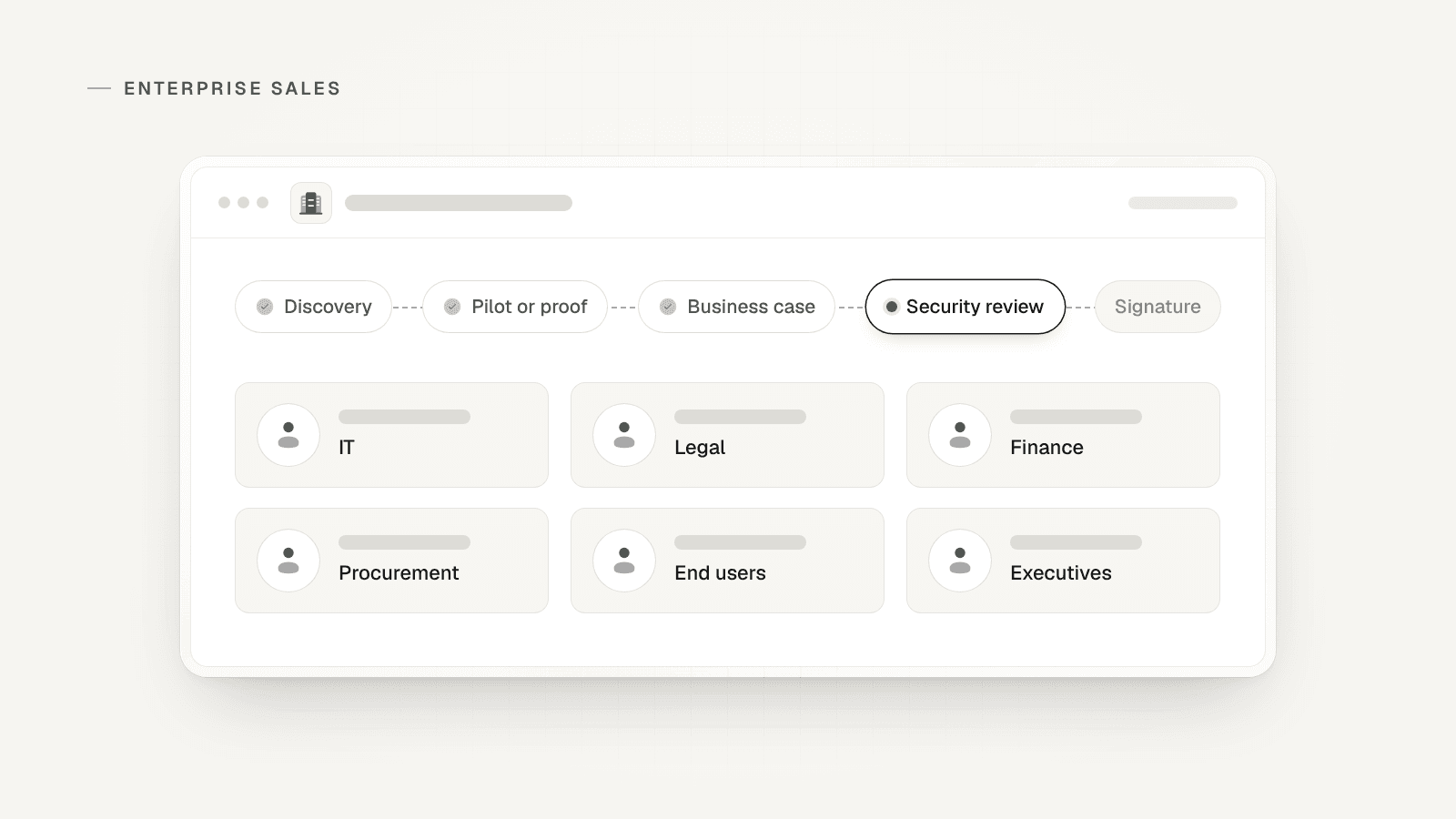
Enterprise sales definition: what does enterprise sales mean?
Enterprise sales is selling to large companies, as Salesforce's guide puts it. One deal may carry a large business impact, a contract that runs for several years, a complex rollout or a lot of risk.
It is also called complex sales. The buyer often asks several vendors to bid and brings in decision makers from many departments. DealHub's glossary adds that these deals can run into millions of dollars.
Enterprise sales is one kind of B2B sales, where one business sells to another. Our B2B sales guide covers the basics.
Sources: Salesforce: the complete guide to enterprise sales, DealHub glossary: what is enterprise sales?
Enterprise vs mid-market vs SMB sales: what changes?
The bigger the buyer, the more people decide, the bigger the deal and the longer the sale. Close, which sells CRM software for tracking customers and deals, sorts companies into three groups. SMBs (small and medium-sized businesses) have fewer than 100 employees. Mid-market companies have 100 to 1,000, and enterprises have more than 1,000.
Treat those lines as one example. Salesforce's SMB guide uses similar cutoffs and calls the numbers subjective.
Deal size grows with the buyer. In a 2014 example by investor Christoph Janz, a small business pays $1k or more a year. A medium-sized company pays $10k or more, and an enterprise customer $100k or more.
Sources: Close: SMB vs mid-market vs enterprise sales (updated June 2026), Salesforce: SMB sales, a complete guide, Christoph Janz: five ways to build a $100 million business (2014)
Enterprise vs mid-market vs SMB sales at a glance
Close's and Janz's examples, row by row. Your own market may draw the lines in other places.

| Question | SMB | Mid-market | Enterprise |
|---|---|---|---|
| Employees (Close) | Fewer than 100 | 100 to 1,000 | More than 1,000 |
| Yearly deal size (Janz, 2014) | $1k or more | $10k or more | $100k or more |
| Who decides (Close) | 1 to 3 people, often the founder or owner | End users, directors and 1 or 2 top executives | 7 or more people across departments and executives |
| Sales cycle (Close) | Usually under 4 months | 4 to 12 months | Often 6 to 18 months or more |
| How it is sold (Close) | Referrals and advice-led selling | Mapping who has a say, plus case studies | Pitches made for each target account |
| Before the contract (Close) | Fast decisions, often after cold outreach | A more formal evaluation | Starts inside the buyer, with many approvals and demos |
Why do enterprise deals take so long?
Because more people and more checks stand between you and the signature. Salesforce compares two sales of the same copiers. The owner of a local law firm can decide alone, and the order could arrive a week later.
Sell the same copiers to an international law firm, and IT checks how they connect to its systems. An operations team plans the install and training. Procurement may send a request for proposal, a formal call for vendors to bid. Add it up, Salesforce says, and the sale will likely take many months.
Salesforce adds that enterprise deals often include 10 or more stakeholders, and all of them need to buy in. If you don't win them over, it warns, you can waste a year selling to the wrong people.
What are the stages of an enterprise sales process?
You can split an enterprise deal into eight stages: choosing accounts, first meetings, discovery, pilot, business case, security review and procurement, signature and expansion. Salesforce sums up the work as four D's: define, discover, develop and deliver. Apollo, a sales software company, lists six steps from account research to the contract.

- Choose and research accounts: rank large companies by how well they match your product, drop the rest, and map who will have a say.
- First meetings: reach several people at each account by email, LinkedIn and phone.
- Discovery: learn their problems, current tools, budget timing and how they will judge success.
- Pilot or proof: the buyer tries the product on a small scale, such as one department for a set time, against goals you agree on.
- Business case: show the leaders who approve the budget the return they can expect, with case studies from similar companies.
- Security review and procurement: the buyer's IT team checks your security, legal reviews the contract and procurement runs the purchase.
- Signature: the contract is signed, often for several years.
- Expansion: grow the account after the sale, for example by adding products.
Sources: Salesforce: the complete guide to enterprise sales, Apollo: what is enterprise sales? (January 2026), HubSpot: sales POC, five steps for success, DealHub glossary: what is enterprise sales?
Who is on an enterprise sales team?
Salesforce lists six roles: a BDR who finds prospects, an account executive, a solution architect, a digital advisor, a sales leader and customer success. On a small team, one person may do several of these jobs.
- BDR (business development representative): finds new, qualified prospects through cold outreach.
- Account executive: manages customer relationships and finds chances to build new ones.
- Solution architect (some teams have a similar role called a solutions engineer): shows how the product fits the software the buyer already uses.
- Digital advisor: plans how new technology will change the buyer's business.
- Sales leader: runs the team and plans its growth.
- Customer success: improves the customer's experience and gets more people using the product.
How do you find and research enterprise accounts?
Start from a short list of accounts that fit your ICP (ideal customer profile), then map several people in each. Here is how three sellers could do it in OXYGEN for 40 US logistics companies with more than 1,000 employees.
AI does the research and drafting within the approvals and spending limits you set. Paid steps use credits, OXYGEN's usage currency.
- Build the list: Company Search filters companies by industry, headcount and location. The preview is free; filling the table is priced first and needs your approval. A CSV import is free.
- Check the fit: a Classify column labels each company SMB, mid-market or enterprise from its headcount. Another scores its ICP fit as low, medium or high, with a reason.
- Find the people: the "Find decision makers at companies" source lists people at each account by job level, function and country. A free sample comes first, and each person stays linked to their company.
- Research each account: a Web Research Agent column answers one question per company from the live web. Ask what it sells or whether it raised money; each answer cites its sources.
- Reach out: one sequence, a planned series of emails, LinkedIn messages and call tasks, runs for each person. Nothing sends until you start it from the Review & start step.
- Pause the account on a reply: a reply stops that person on every channel and can pause their colleagues in the campaign.
- Track the deal: the Pipeline board in OXYGEN's CRM, its database of companies, people and deals, starts with Lead, In Progress, Won and Lost. Add stages such as security review, and link everyone involved to the deal.
What mistakes do teams make in enterprise sales?
Watch for five mistakes: one contact per deal, no business case, procurement left to the end, large logos outside your ICP and long silences. Each can cost months, or the whole deal.
- One contact per deal: reach several people at each account, because all of them need to buy in.
- No business case: Apollo advises showing the executives who approve the deal the expected return, with case studies from similar companies.
- Procurement left to the end: ask in discovery which reviews the deal must pass and who signs.
- Large logos outside the ICP: Salesforce advises dropping accounts that don't match your product. Close warns that startups that chase enterprise deals too early can run out of money first.
- Long silences: a long cycle leaves plenty of time for a deal to fall apart, Salesforce notes. End every meeting with an agreed next step.
Sources: Salesforce: the complete guide to enterprise sales, Apollo: what is enterprise sales? (January 2026), Close: SMB vs mid-market vs enterprise sales (updated June 2026)
Related terms: B2B sales, SaaS sales, BDR, ICP and GTM
You will meet these words next to enterprise sales.
- B2B sales: one business selling to another; enterprise sales is the part aimed at large organizations.
- SaaS sales: selling software that customers pay for by subscription and use online.
- BDR and SDR: reps who find and qualify new prospects before an account executive takes over.
- ICP (ideal customer profile): the kind of company that fits your product best.
- GTM (go-to-market): your plan for bringing a product to buyers.
- Buying group: the people at the buying company who have a say in the purchase.
What OXYGEN does not do for enterprise deals
- No SOC 2 report, ISO 27001 certificate or single sign-on (SSO), which large buyers often ask about in a security review.
- It does not answer security questionnaires or review contracts; that work stays with your team.
- No Salesforce sync; HubSpot syncs both ways, Attio one way, and Pipedrive imports.
- No contact database of its own: company and contact data comes from data providers, on credits.
- Calls are in beta: a call task queues the lead for a person to dial in the web softphone, a phone that runs in your browser.
- It does not hold your meetings: discovery calls, demos, pilots and negotiation stay with your team.
Frequently asked questions
What is enterprise sales?
Enterprise sales is selling products or services to large organizations. The deals are bigger and slower than sales to small businesses, and many people at the buyer must agree.
What counts as an enterprise customer?
There is no single rule. Close counts companies with more than 1,000 employees, often with over a billion dollars in yearly revenue. Apollo uses the same 1,000-employee line, and in Christoph Janz's example an enterprise pays six figures a year.
How long is an enterprise sales cycle?
Plan for 6 to 18 months, and sometimes longer, as Close's range shows. Salesforce says a deal can take months or even over a year. Each review adds time, so ask about the pilot, security and procurement early.
What is the difference between enterprise sales and B2B sales?
B2B sales is any sale from one business to another. Enterprise sales is the part of it aimed at large organizations, with bigger deals, longer cycles and more people involved.
What skills does an enterprise sales rep need?
Salesforce looks for patience balanced with urgency, curiosity, grit and leadership. It adds relationship skills: building trust with many stakeholders, building consensus and negotiating well.
Is enterprise sales a good career?
It can be, if you like long projects and big wins. Salesforce calls it a good place to be, with bigger impact and bigger revenue. The trade-off is fewer, slower deals. Apollo notes that leaders hire account executives with a proven enterprise track record.
How can a small sales team sell to enterprise accounts?
Pick a short list of accounts that fit your ICP and reach several people at each. Close suggests starting with smaller customers unless you have an edge, such as a network or insider knowledge. In OXYGEN, a free workspace gets a one-time grant of 250 credits for lists and research. Adding a mailbox or LinkedIn account to send from needs a paid plan, from $49 a month.
Related
Linked from
Sources
- Salesforce: the complete guide to enterprise sales, checked October 26, 2026
- Salesforce: SMB sales, a complete guide, checked October 26, 2026
- Close: SMB vs mid-market vs enterprise sales (updated June 2026), checked October 26, 2026
- Christoph Janz: five ways to build a $100 million business (2014), checked October 26, 2026
- Apollo: what is enterprise sales? (January 2026), checked October 26, 2026
- DealHub glossary: what is enterprise sales?, checked October 26, 2026
- HubSpot: sales POC, five steps for success, checked October 26, 2026
Updated October 26, 2026. OXYGEN's own prices and limits come from the product and its live price list. The other products named here are trademarks of their owners and are not affiliated with OXYGEN. Something out of date? Tell us.