What is a sales pipeline? Definition, stages and the numbers to watch
Quick answer
A sales pipeline is the list of open deals a sales team is working, grouped by stage from first meeting to signed contract. It shows what each deal is worth, what is likely to close and where deals stall. Give every stage an exit rule, what must be true before a deal moves on, and review the pipeline every week.
 By Tim Scheuer, Co-founder of Oxygen · Updated October 27, 2026
Sales pipeline definition: what is a pipeline in sales?
A pipeline in sales is every deal your team is working that has not closed yet, sorted by stage. Salesforce calls it a visual picture of where each prospect, a possible buyer, is in the sales process. It shows the next step and any delay.
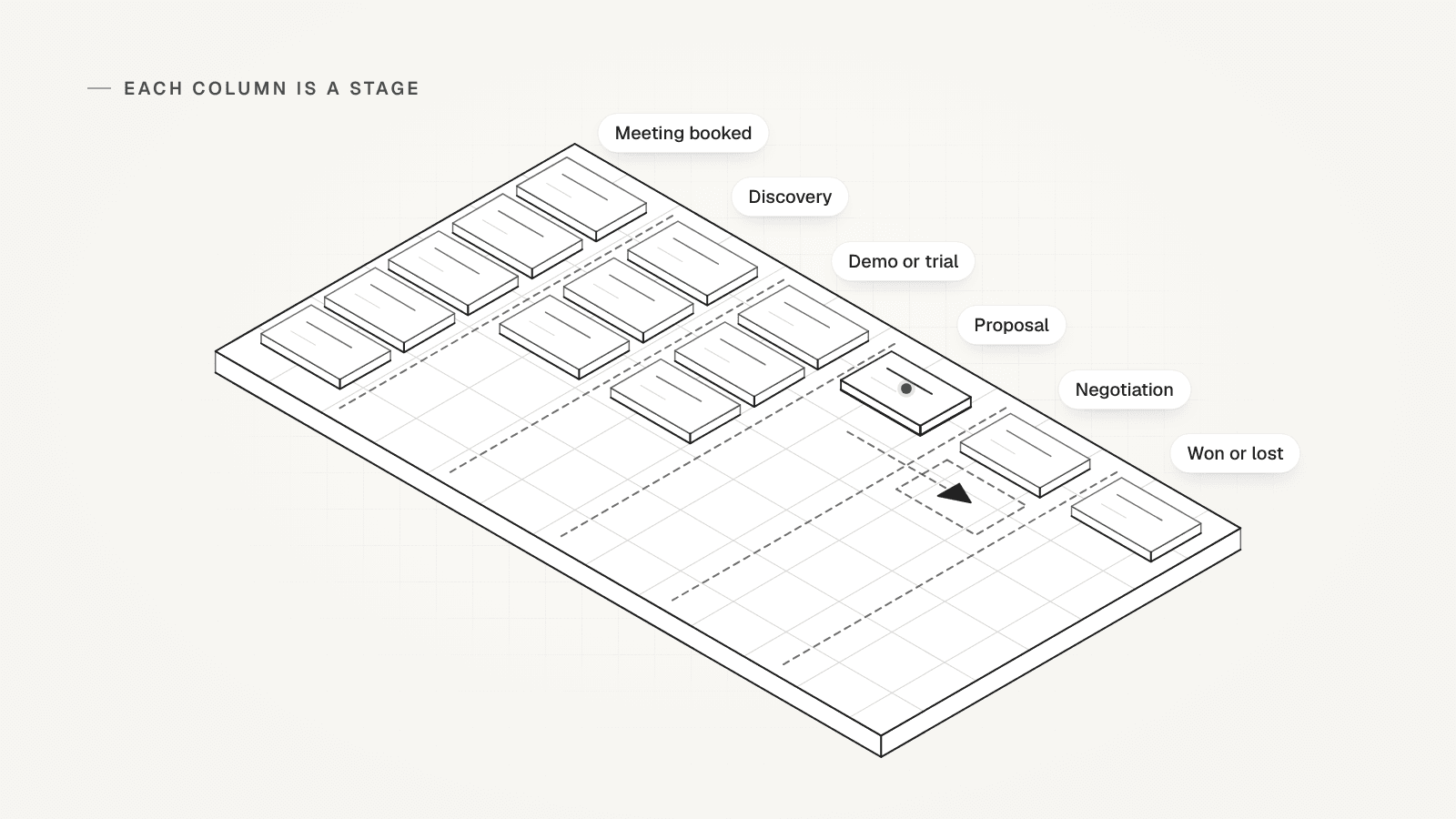
Most teams keep it as a board in their CRM (customer relationship management system), the tool that holds companies, people and deals. Each column is a stage, and each card is a deal and its value.
A lead joins the pipeline once it is qualified as a good fit, Salesforce says. This guide opens a deal at the first meeting with a qualified buyer. Our guide to B2B (business-to-business) sales covers the sales cycle around it.
Sources: Salesforce: what is a sales pipeline, and how do you build one?
Sales pipeline vs sales funnel vs sales forecast: what is the difference?
A sales pipeline is the seller's view of open deals, and a sales funnel is the buyer's path to a purchase. A sales forecast is the revenue you expect to close in a set period.
Salesforce draws the funnel from the customer's side, from awareness to evaluation and purchase. HubSpot's guide says a forecast uses past results, market trends and the current pipeline. Its author, Mark Burdon, puts it simply: the pipeline is how deals move, and the forecast is what you will land.
Sales educator Jeff Hoffman, cited by HubSpot, pictures a pipeline as a wide-mouthed cocktail glass, not an even funnel. Most prospects drop out at qualification, and most who pass it should buy.
Sources: Salesforce: what is a sales pipeline, and how do you build one?, HubSpot: sales pipelines, a walkthrough for sales leaders and reps (Dec 2025)
Sales pipeline vs sales funnel vs sales forecast at a glance
Salesforce's and HubSpot's definitions, side by side. All three use the same deals, so keep them in one place.

| Question | Sales pipeline | Sales funnel | Sales forecast |
|---|---|---|---|
| What it is | The seller's view of open deals and their stages | The buyer's path, from discovery to purchase | An estimate of revenue for a set period |
| What it counts | Deals, each with a stage and a value | Prospects at each step, fewer at each one | What will close, for how much and when |
| Built from | Deal records in your CRM | Data much like the pipeline's | Past results, market trends and the current pipeline |
| The question it answers | What is the next step on each deal? | How engaged is the buyer? | Will we hit the number, and how sure are we? |
What are the stages of a sales pipeline?
A B2B sales pipeline usually runs from a first meeting through discovery, demo, proposal and negotiation to won or lost. Salesforce lists seven stages, from prospecting to post-purchase.

What moves a deal on is an exit rule, which Salesforce calls exit criteria. HubSpot's guide wants an objective rule for each stage, such as "discovery completed with decision maker", not "feels warm".
Here is a sample sales pipeline for a B2B team: six stages, each with the rule that moves a deal on. Name them in your team's own words.
- Meeting booked: a qualified buyer agreed to a first call. Exit rule: the call happened, and they have a problem you solve.
- Discovery: learn the need, budget, timeline and who decides, the four things Salesforce suggests asking. Exit rule: all four are confirmed.
- Demo or trial: the buyer sees the product work on their problem. Exit rule: they agree it fits and ask for a price.
- Proposal: you send the price and terms. Exit rule: the buyer has read it and set a date to decide.
- Negotiation: both sides settle price, terms and start date. Exit rule: the contract is out for signature.
- Won or lost: the contract is signed, or the deal is closed as lost. Log the reason either way.
Sources: Salesforce: what is a sales pipeline, and how do you build one?, HubSpot: sales pipelines, a walkthrough for sales leaders and reps (Dec 2025)
Which sales pipeline metrics matter?
Track seven numbers: open deals and value, stage conversion, win rate, deal size, cycle length, pipeline velocity and coverage. The formulas follow HubSpot's guides. Count each one the same way every week, or the trend means nothing.
An example with round numbers: 40 open deals, a 25% win rate, an $8,000 average deal and a 60-day cycle. Velocity is 40 × 0.25 × $8,000 ÷ 60, about $1,333 of pipeline value a day.
- Open deals and pipeline value: the deals not yet won or lost, and the sum of their amounts.
- Stage conversion: deals that moved on from a stage ÷ deals that entered it.
- Win rate: deals won ÷ deals closed (won plus lost). HubSpot's guide divides by leads, opportunities or meetings, so say which you use.
- Average deal size: revenue from won deals ÷ the number of won deals.
- Sales cycle length: total days to close ÷ the number of deals closed.
- Pipeline velocity: (open deals × win rate × average deal size) ÷ cycle length in days, the value moving through the pipeline each day.
- Coverage: pipeline value ÷ your target for the period. HubSpot says most successful sales teams keep 3:1 to 5:1.
Sources: HubSpot: sales pipelines, a walkthrough for sales leaders and reps (Dec 2025), HubSpot glossary: sales pipeline coverage
How do you build a sales pipeline from scratch?
Work back from your revenue target to the first meetings you need each week, then fill them from accounts that fit. HubSpot's guide does the math in two steps.
Deals needed = target ÷ average deal size. Deals to open = deals needed ÷ the share of opened deals you win, stalled ones included. A $150,000 quarter with $10,000 deals needs 15 wins. At one win in four, open 60 deals, about five first meetings a week.
- Pick one place for deals, a CRM. HubSpot's free CRM includes deal pipelines, and OXYGEN's CRM is free on every plan.
- Write your ICP (ideal customer profile), the kind of company that buys from you, and set your stages and exit rules.
- Build a list of companies that fit the ICP, with the people at each one who would buy.
- Reach out with a sequence, a planned series of emails, LinkedIn messages and calls, until each person replies.
- Open a deal at each first meeting, with an owner, an amount and a next step with a date.
Sources: HubSpot: sales pipelines, a walkthrough for sales leaders and reps (Dec 2025), HubSpot: free CRM software and its plans
How do you manage a sales pipeline week to week?
Review the pipeline once a week, and give every open deal a next step with a date. Mark Burdon, writing for HubSpot, books 25 minutes with the live pipeline on screen.
First come 2 to 3 minutes on what moved: won, slipped (the close date moved out) or added. Then 15 to 18 minutes go to deals that can close this month or look stuck. Last comes a read-back of who does what, by when.
Then clear out stale deals. Salesforce says prospects must move to the next stage in a set time, or leave the pipeline. When a deal has no next step booked, Burdon moves it to nurture (light, regular contact until the buyer is ready) or closes it.
Keep this apart from the forecast review, which asks what will close and for how much.
Sources: HubSpot: sales pipelines, a walkthrough for sales leaders and reps (Dec 2025), Salesforce: what is a sales pipeline, and how do you build one?
How do you track a sales pipeline in OXYGEN?
OXYGEN's CRM keeps every deal on a Pipeline board, and a Pipeline dashboard shows the numbers for your weekly review. Both are free on every plan, the free one included.
A new workspace, your team's OXYGEN account, starts with eight sample deals. Each one's record shows a Sample badge, and the dashboard leaves samples out of its totals.
- Set your stages: the Deals board starts with Lead, In Progress, Won and Lost. Rename them or add your own in Settings, under CRM Data Model.
- Add the deal: link its company and people, and give it an owner, an amount and a close date.
- Move it on: drag the card to the next column once the buyer meets that stage's exit rule.
- See replies: a reply to your outreach lands on that person's CRM timeline, and their sequence stops on every channel. Sending needs a paid plan, from $49 a month.
- Book the next step: add a task with a deadline. The Tasks page under CRM lists every open task, with a Mine filter.
- Review the numbers: the Pipeline dashboard shows deals and value by stage, win rate, revenue won and cold deals (open, no activity in 14 days). It is not in the sidebar: open /dashboards/pipeline.
What mistakes do teams make with their sales pipeline?
The common ones are stages without exit rules, too many stages, stale deals, activity counted as pipeline and deals spread across tools. Each makes the pipeline look bigger, or less true, than it is.
- Stages without exit rules: if two reps can't agree on what moves a deal, the stage is not clear enough, says Mark Burdon in HubSpot's guide.
- Too many stages: Burdon merges any two stages that hold the same deals for weeks.
- Stale deals: a deal with no next step for weeks still counts in the total. Close it or move it to nurture.
- Activity counted as pipeline: 200 emails sent is not pipeline. Count only deals where a buyer agreed to talk.
- Deals spread across tools: stages in a spreadsheet, notes in email, replies in one rep's inbox. Keep one record per deal.
Sources: HubSpot: sales pipelines, a walkthrough for sales leaders and reps (Dec 2025)
Related terms: sales funnel, forecast, coverage and velocity
You will meet these words next to sales pipeline.
- Sales funnel: the buyer's path, from first hearing of you to buying.
- Sales forecast: the revenue you expect to close in a set period.
- Pipeline coverage: pipeline value divided by your target for the period.
- Pipeline velocity: the value that moves through the pipeline each day.
- Deal stage: one step of the pipeline, with an exit rule that moves a deal on.
Sources: Salesforce: what is a sales pipeline, and how do you build one?, HubSpot: sales pipelines, a walkthrough for sales leaders and reps (Dec 2025), HubSpot glossary: sales pipeline coverage
What OXYGEN does not do for your pipeline
- No revenue forecast: the dashboards show deals by stage, what you won and what went cold, not what will close this quarter.
- No Salesforce sync; HubSpot syncs both ways, Attio one way, and Pipedrive imports.
- No calendar sync, permissions per record or mobile app.
- It does not check exit rules: anyone on the team can drag a deal to the next stage.
- It does not run the sale: discovery calls, demos and negotiation stay with your team.
Frequently asked questions
What is a sales pipeline?
A sales pipeline is the set of open deals a sales team is working, grouped by stage from first meeting to signed contract. It shows what each deal is worth, how far along it is and where deals stall.
What are the stages of a sales pipeline?
A common B2B set is meeting booked, discovery, demo or trial, proposal, negotiation, and won or lost. Salesforce lists seven stages, from prospecting to post-purchase. Give each one an exit rule, so everyone knows when a deal moves on.
What is the difference between a sales pipeline and a sales funnel?
The pipeline is the seller's view: the deals you are working and the stage each one is in. The funnel is the buyer's view: how people move from first hearing of you to buying. Salesforce notes that both draw on similar data.
How do you calculate pipeline velocity?
Multiply your open deals by your win rate and your average deal size, then divide by your sales cycle length in days. That is the value moving through your pipeline each day. To raise it, add deals, win more, sell bigger or close faster.
How much pipeline do I need to hit my number?
HubSpot says most successful sales teams keep three to five times their target in open pipeline. Teams with lower win rates or longer cycles need more. As a check, divide 1 by your win rate: winning one deal in four means about four times your target.
How do you build a sales pipeline from scratch?
Divide your target by your average deal size to get the wins you need. Divide that by your win rate to get the deals to open. Then reach out to accounts that fit your ICP until enough buyers agree to meet.
Is there a free tool to track a sales pipeline?
Yes. OXYGEN's CRM, with its Pipeline board and dashboards, is free on every plan. A free workspace also gets 250 credits once, OXYGEN's usage currency. Sending outreach needs a paid plan, from $49 a month. HubSpot's free CRM includes deal pipelines too.
Related
Sources
- Salesforce: what is a sales pipeline, and how do you build one?, checked October 27, 2026
- HubSpot: sales pipelines, a walkthrough for sales leaders and reps (Dec 2025), checked October 27, 2026
- HubSpot: free CRM software and its plans, checked October 27, 2026
- HubSpot glossary: sales pipeline coverage, checked October 27, 2026
Updated October 27, 2026. OXYGEN's own prices and limits come from the product and its live price list. The other products named here are trademarks of their owners and are not affiliated with OXYGEN. Something out of date? Tell us.